
As data professionals, our job is to help others do their job the right way through data. We give them insights into their processes, actions and campaigns. Telling, or more importantly, showing what works and what doesn’t. Our work guides the next decision, action and project. That’s the crux of our job.
However, that’s an ideal situation that doesn’t exist. Or does it? You feel like your work is a supplementary document to the company’s decisions. No matter how good your analysis is, how clean the data is and how good the numbers are, it’s always a nice-to-have rather than a necessity and guidance.
I don’t know about ideal, but you can turn the tables and bring your work to the front row if you know how to influence. Influence through data, showing its real value and making it a guide for the decision-makers.
The question of authority
Position brings authority, that’s a fact. And authority brings influence. But how do you influence when you don’t have the position, or despite having the title, you’re not the primary decision-maker? Simply stating the facts and numbers isn’t enough.
Many of us drown in self-pity, thinking our work doesn’t have influence because we don’t have authority. But what we forget is credibility.

Ditch authority, build credibility
Ever had a leader whose say was not valued enough or was considered only because they had authority? There’s a high chance they didn’t have credibility.
Credibility is your biggest asset and superpower that leads to influence. People listen to those they trust. It is what makes stakeholders pay attention, even when your insights challenge their assumptions. It’s what turns “another report” into a recommendation worth acting on.
So ditch authority, start building credibility through your words and actions. The following 5 tips will help you build both credibility and influence at work.
Also read: How to be an inspirational leader
How to influence at work as a data professional
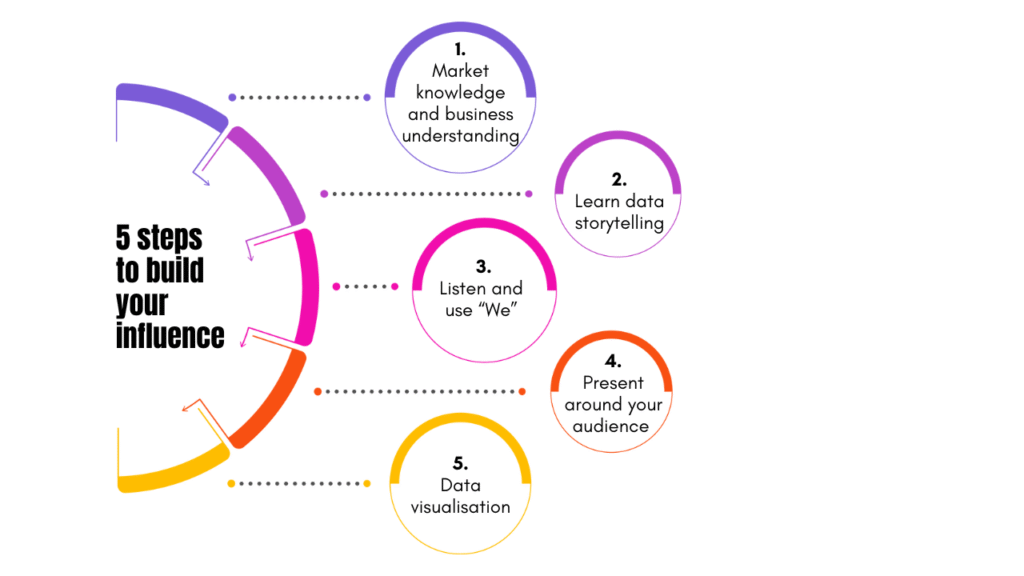
1. Market knowledge and business understanding
Knowing what’s going on in the market, what’s in demand, what the trends are, what the new buzzword is, and having a deep understanding of your company’s position, priorities, goals, weak spots, and struggles is a deadly combination that brings credibility.
Your opinions and solutions are not isolated and based only on data, but they are derived from the big picture of everything that’s going on in the company and the market. When people know you talk holistically, they value your opinions and solutions more.
A pro tip: When presenting your analysis, connect it with the business and the market. That’s how you position yourself for credibility.
2. Learn data storytelling
Presenting the data is not enough. Numbers don’t move people. The story around them and the meaning behind them do. I have a dedicated article on data storytelling that gives you a simple framework to go from stating numbers to becoming a data storyteller, you can check that out.
A pro tip: before you draft your story, think about the core emotion linked with the data or the decision. It can be fear, desire for growth, FOMO or a new market trend. Build your story from these emotions, as they are the core factors that move the needle.
Talking about meaning, always put the number in perspective or context so the audience can comprehend its meaning. Here are a few examples:
- Your analysis reveals that operational costs rose by 7% this quarter. At first glance, that sounds worrying, but when you put it into context, it might actually be a good thing.
“Operational costs rose by 7% this quarter, but revenue grew by 12% in the same period. That means our cost-to-revenue ratio actually improved, indicating the business is scaling efficiently despite higher expenses.”
- Your report shows that the company generated 320 tons of waste last year. Just stating the number doesn’t signify its impact.
“The company generated 320 tons of waste last year, which is roughly equivalent to the weight of 50 adult elephants.” Now you can get a better sense of the number.
3. Listen and use “We”
Before you try to convince someone with data, take time to listen to what matters to them. What are their goals, pressures, or fears? What outcomes are they trying to achieve or avoid? When you acknowledge those concerns, even better when you ask about them, you shift from being a presenter to being a partner.
And as you communicate, use “we” instead of “you.” It’s a small linguistic choice, but it signals shared ownership and accountability.
“We can reduce the risk by…” sounds more collaborative than “You need to address this.”
4. Draft your entire presentation around your audience
Know your audience is generic advice, but it is the most important one.
No matter how well you draft your presentation, how clearly you present the data and how well you communicate, it’s all in vain if it doesn’t sit right with the audience. And interestingly, what’s good is subjective, depending entirely on who’s listening. A perfect data presentation for your data team, including model accuracy, parameters, and trends, would leave executives lost and confused.
That’s why, before you even open your slide deck, take time to understand how your audience makes decisions and what influences those decisions.
- What outcomes are they optimising for: growth, risk reduction, cost savings?
- What pressures shape their choices: time, budget, stakeholders?
- What specific information do they need to feel confident saying yes or no?
5. Data visualisation
The further you move from technical audiences, the simpler and more visual your presentation should be. Your peers might enjoy a deep dive into the model, but senior leaders need a story they can grasp at a glance.
Replace dense tables with clear visuals. Summarise key insights in one sentence. Lead with “what this means” before “how we found it.”
Also read: How to use BLUF method in your communication?
Final thoughts
Building influence might seem like a challenge that requires authority and power. However, it lies in our simple everyday actions. As a data professional, our communication with others matters the most. It positions us in a place of credibility that brings influence.
If you’re an aspiring data leader who wants to step out of technical tasks or managerial roles and take your next career step, my data leadership mentoring program can help you. It’s an 8-week mentorship that’s designed to help data professionals like you take the next career step you want to but don’t feel prepared for.
Learn more about data leadership mentoring here.








![How to use AI in spend analytics? [5 use cases]](https://feriotti.com/wp-content/uploads/2026/04/1-3.png)