
If you’re a data analyst, chances are you’ve had this moment: You’re knee-deep in SQL, juggling dashboards, answering ad-hoc requests like a vending machine, and suddenly it hits you,
“Wait. Is this it? Is this my whole career?”.
And it’s not that you don’t love data. You do. You’re good at it.
But every time you scroll through LinkedIn, someone you know has become a senior analyst, a data scientist, or an analytics engineer, while you’re still stuck explaining how the dashboard is not broken, the data is.
If you’re contemplating what’s the next step in your data career and how you can move forward in this industry, this article is your guide. It will lay out all the options for you so you can make informed decisions at the right time, all coming from an ex-scientist, data consultant and currently a fractional CTO.
Data analyst career progression
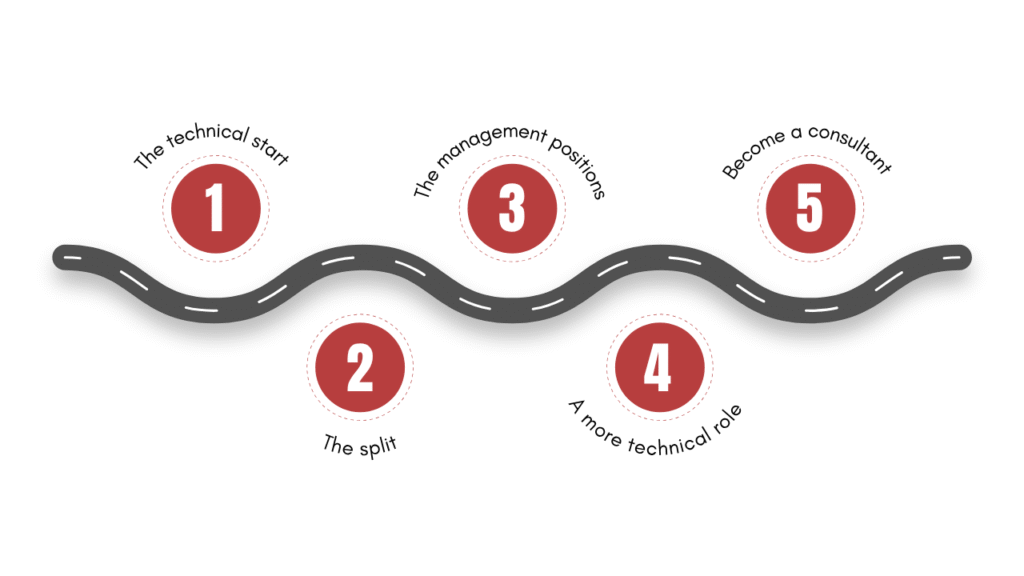
The technical start
The first step is to get a data analyst role. If you’re just entering the industry, you will be a junior data analyst. With experience and time, you will move one step up and become a mid to senior analyst. That’s your technical start as a data analyst.
Your day-to-day work will centre on dashboards, analytics tools, data analysis, and the technical tasks that support them. You’ll be an individual contributor, responsible for your own work and reporting to your manager or boss.
Usually, it takes 1 to 2 years to transition to a senior data analyst role. The skills are the same at this position, but at a different level. Your experience will give you command over the tools and technicalities of your work. As a senior analyst, you will have more responsibility and ownership of your work, allowing you to handle bigger projects.

The split
Now here comes the point where the road splits, and you have to choose your direction. You can either grow into more technical roles, such as a data scientist or a specialised consultant, or you can go towards managerial roles leading to leadership positions.
I’ve put this split here for two reasons. Firstly, for the ease of understanding. However, everyone’s journey is different, and you can change routes whenever you want. It’s not a hard rule; it just sits here in my hierarchy for simplification.
Secondly, the first part (the technical start) is where people are exploring the industry and getting a hang of it. It’s only after this stage that they decide on a career path.
Let’s see the options you get at this split. Your pick will decide your career trajectory, but remember, you can shift anytime you want 😉
Also read: How To Become A Data Product Manager: A Guide For Data Pros

The management and leading positions
Your first option is to climb the same ladder and get promoted to a managerial role, which is the next linear step in career progression for a data analyst. This is where the leadership enters the picture, and the technical aspect starts to fade as you progress.
Your work now will revolve more around people, meetings and presentations. To acquire a lead role, you will need to develop leadership skills, including communication, active listening, empathy and negotiation.
I’ve already covered the 10 most important leadership skills with a practical framework to learn them. Here’s your cue: How to build 10 soft leadership skills you need for a lead role.
The progression starts with becoming a team lead, then director of analytics or head of department, and the last step of this ladder is chief data officer (CDO). You might informally start your leadership journey by leading or managing a project.
There might be different titles in this journey, or you might get a promotion under the same title as your team and responsibilities grow, resulting in a salary hike. But the path from here is to move higher in leading roles, and as you do that, your role becomes more about soft skills and less technical.
Also read: Technical Vs Management Career Path: Which Is Better For You?

The pivot to a more technical role
If you decide to stay on the technical side, either due to love of data or because people-centric roles are not your thing, one option is to steer towards data science or data engineering. These are more technical roles than data analyst and require additional technical skills and qualifications. The transition is heavy on learning. You will need advanced coding skills with AI and machine learning.
You can find worthwhile courses on platforms like Coursera and Udemy.

Specialise and become a consultant
Another career path of a data analyst who wants to retain the technical aspect without shifting towards data engineering or science is to specialise in a domain and become a consultant. Think of financial, operational, business and healthcare analysts.
When data analysts have spent 4 to 6 years in a specific industry, they bring deep domain expertise with their technical knowledge.
Your projects diversify as you work with different firms, dealing with unique problems and situations. However, if you don’t move into managerial roles, you will be stuck at a senior data analyst position before you build the required skills and experience for consulting.
You can either work for a consulting agency or operate independently as self-employed.
Remember, the latter comes with its own unique skill set to sustain the business. Finding clients, keeping your pipeline steady and marketing your services is part of the game. The network you would have built throughout the years will be a huge help. If you want a structured corporate routine, then the consulting firm will be your best bet.

Your last reminder: Data Analyst Career Progression
Note that career progression isn’t linear. Many mid-level leaders and managers do consulting as well due to their years of experience, and some take it full-time at this point in their career. You can also jump into leading roles and even into consulting after becoming a data scientist or engineer.
The path isn’t fixed; you can turn whenever you want. But it’s important to know all your options.
If you’re a data analyst who wants to move into leadership roles but doesn’t know where to start, you can explore my 8-week mentorship program, where we work together to equip you with the right mindset and skills to secure that promotion. Or you can book a 15-minute 1:1 consultation with me.






![How to use AI in spend analytics? [5 use cases]](https://feriotti.com/wp-content/uploads/2026/04/1-3.png)