
We’ve all sat through meetings that should’ve been an email. Or back-to-back calls with no clear agenda, no decisions, and no real outcome, just time slipping away.
As a new manager or lead, this is where the pressure hits. You run meetings now and don’t want yours to be like the ones you’ve hated yourself.
This guide breaks down how to lead a successful team meeting, from setting the right outcome to driving action so your meetings create clarity, alignment, and real progress instead of frustration. And all that just through simple and minor changes that yield a big impact in making a meeting effective.
How to conduct effective and successful team meetings
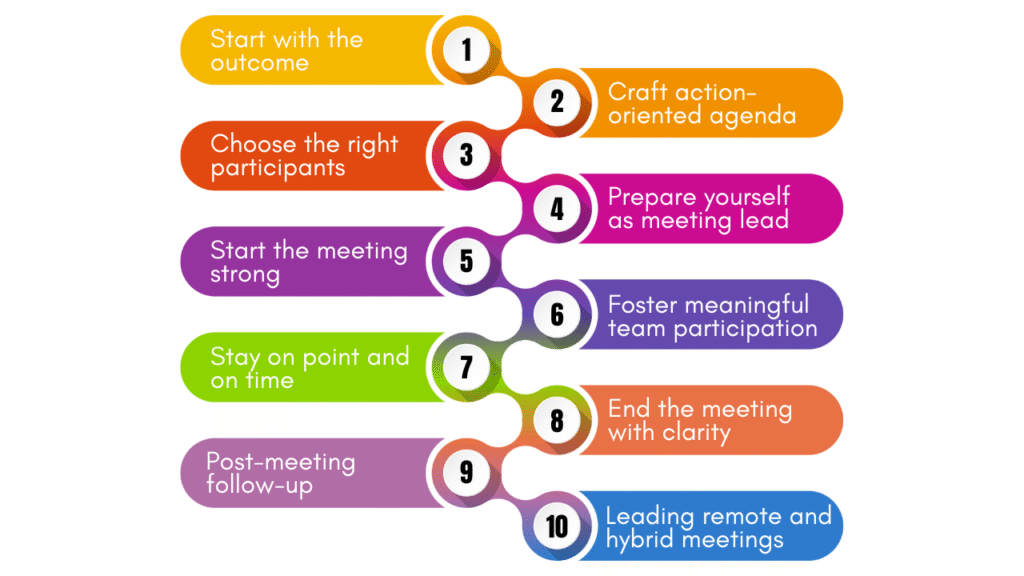
1. Start with the outcome, not the calendar invite
Most meetings fail before they even start, right at the moment you send the calendar invite. Because we often begin with when instead of why. “Let’s meet tomorrow and discuss” is easy, but defining what actually needs to change because of that meeting takes time, thought, and leadership.
Before you schedule anything, ask yourself one simple question:
What must be true when this meeting ends that isn’t true right now?
A successful team meeting always has an outcome. Maybe it’s a decision, maybe it’s alignment, or maybe it’s a clear plan forward. But it’s never just “discussion”. Every meeting you arrange is to move the team forward. If that isn’t there or it can be achieved without a meeting, it’s not worth calling one.
Once the outcome is clear, the rest becomes easier:
- You know what needs to be discussed
- You know who actually needs to be in the room
- You know how long the meeting should be
It’s necessary that you define these three points clearly and purposefully choose the attendees.
2. Craft a clear, action-oriented agenda
When you walk into a meeting with a vague agenda, or worse, none at all, you’re telling the team you haven’t thought upfront. And when the leader hasn’t thought things through, the meeting drifts, dominant voices take over, and time gets wasted.
Every agenda item should be tied to an action or decision. “Discuss Q3 roadmap” and “Team updates” are bad examples of defining the team agenda. A better way to say it is “Decide Q3 roadmap priorities” and “Surface blockers that need leadership support”.
A strong agenda answers three questions before anyone speaks:
- Why are we here?
- What are we covering?
- What needs to come out of this meeting?
Keep it simple:
- Start with the meeting outcome
- List topics with time limits
- Assign an owner to each topic
- Clarify the expected result (decision, input, alignment)
Share this information with every attendee so they’ve time to prepare and know what to expect. And that’s how you conduct an effective team meeting: by making the direction visible from the start.
3. Choose the right participants
New leads often invite broadly to be “inclusive,” but effective leadership is selective. Ask yourself: Who is needed to decide? Who is needed to contribute? Everyone else can stay informed asynchronously. If someone isn’t expected to speak, think, or decide, they don’t need to be there.
4. Prepare yourself as the meeting lead
You not only have to prepare to run the meeting but also guide it. You will be the one creating clarity, direction, and forward motion.
Go in knowing the context, the tensions, and the decisions that might surface. Think through what could derail the conversation and how you’ll bring it back. That mental prep is what allows you to stay calm, neutral, and authoritative.
5. Start the meeting strong
The first five minutes decide whether the meeting will be productive or painful. New leads often waste this window by waiting for late joiners, easing into casual chatter, or assuming everyone already knows why they’re there.
State the purpose clearly: Open by reminding everyone why the meeting exists and what must be achieved by the end.
Walk through the agenda and time limits: Confirm what will be covered and how long you’ll spend on each topic. This sets boundaries and signals that time will be respected.
Clarify how decisions will be made: Say upfront whether this meeting is for input, alignment, or a final decision and who owns that decision.
6. Foster meaningful team participation
We often assume participation will happen naturally. It doesn’t. Just reflect on your own individual contributor era.
Without guidance, the same few voices dominate while others mentally check out. You don’t have to make everyone speak, but it’s important that everyone feels safe to share their thoughts and feel heard and valued as a form of reinforcement for future contributions.
Let the team know the meeting isn’t a passive update session. People are there to think, challenge, and add value. Ask specific, directed questions instead of throwing the floor open. Invite input from those closest to the problem, not just the most confident speakers.
When imbalance shows up, calmly intervene. Redirect dominant voices and pull quieter ones in through context. That’s your role as a leader: to quietly and deliberately facilitate everyone speaking up.
7. Stay on point and on time
When conversations go off-track, acknowledge the point, then guide it back to the outcome. A simple “Let’s park this and come back if we have time” keeps the flow without shutting people down. If a topic runs long, decide in the moment: cut it, extend it consciously, or assign it offline.
8. End the meeting with clarity
In the end, reiterate the final outcome, action points, timelines and the assignees. It ensures everyone walks away with clarity and knowing their next moves. Don’t forget to check for gaps. Ask if anything critical is missing or unclear.
9. Post-meeting follow-up
Don’t treat follow-up as optional admin work. It’s a necessary step that ensures the meeting was effective. And that’s how people take meetings seriously. If they know it’s just a formality and no one will refer to it again, they will drift away.
Share a short, focused summary soon after the meeting. Capture decisions, action items, owners, and deadlines, nothing fancy. You can even delegate this task. Then follow through. Check progress, remove blockers, and close loops to make execution possible.
10. Leading remote and hybrid team meetings
Remote and hybrid meetings fail for one simple reason: they’re run like in-person meetings, just on a screen. Remote meetings demand extra attention from the host. Cameras on doesn’t mean people are with you. Attention is fragile, and without structure, remote participants disengage fast.
Be more deliberate than you would in a room. Set participation norms upfront, call on people by name, and pause often to invite input. Don’t let the conversation revolve around whoever is physically present or most vocal.
Final thoughts: How to conduct successful team meetings
Being able to run an effective meeting is one of those leadership skills that seems minor, but quietly defines how focused, respected, and productive you are as a leader. Do it poorly, and meetings drain energy. Do it well, and your team move faster with less friction.
If you’re stepping into leadership for the first time, Foundations of Leadership for Nerds gives you the mindset shifts and practical frameworks to lead with clarity and confidence, especially in tech and data teams. It’s your shortcut to making leadership feel manageable, not overwhelming.







![How to use AI in spend analytics? [5 use cases]](https://feriotti.com/wp-content/uploads/2026/04/1-3.png)