This article is a short perspective shift for the leads and managers who are struggling in their roles. The article will help you see through a different lens that masks the horror you’re facing and makes things a little pleasant.
The shaky bridge between IC and the Leadership mindset is where we suffer
When we shift from our familiar Individual contributor role to a leadership or management position, we need to change our mindset and perspective of work, progress and what success looks like in our new role. But we’re so excited for the new beginning that we forget that, or nobody tells us. We find it out the hard way.
So new leads and managers start their leadership journey with the same old Individual contributor mindset. They stop on the bridge until they figure out their next steps. And this is the suffering zone. It’s a mismatch between your perception and reality that makes you feel overwhelmed and all over the place. We need to jump from the suffering zone to the leadership mindset.
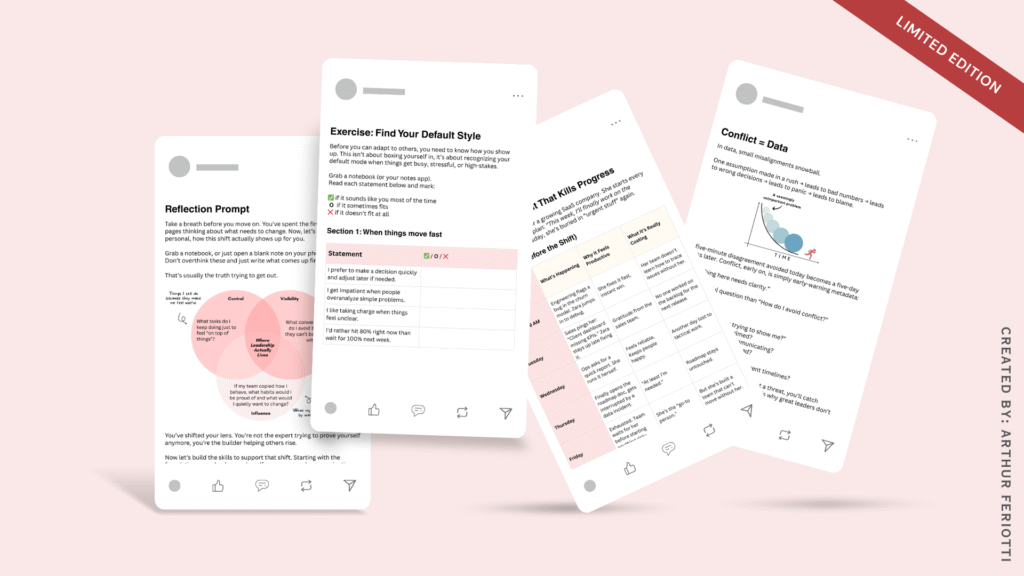
I have a dedicated chapter on the mindset shift new leaders need in my e-book: Foundations of Leadership for Nerds. It’s a deep dive into what the right and wrong leadership mindset is, while holding your hand to help you cross the bridge.
It shows you your limiting beliefs and mindset. It also shows you how to correct them. However, this article is going to be a little sneak peek into the e-book as I briefly discuss the leadership mindset and identity shift.
The gap and the jump
Let’s examine what’s happening now.
You stepped into your new role, excited to create a bigger impact with your technical expertise and experience. You thought you’d lead, solve bigger problems, guide and direct others and enjoy a different level of technical domain, like a tech bootcamp where you’re the instructor, guiding everyone, and then proudly solving the problems they couldn’t solve. Sounds cool!
But then reality struck you hard. You’re not solving big technical issues; you’re in meetings all day. You’re not hands-on with code and dashboards, you’re strategising and explaining your pov to execs and other departments. You’ve to carefully place your precious tech jargon into a box and close it, which honestly feels like you’re losing your identity, because come on, that’s who you are. You question your approach, the new role and your value and worth.
If problems like these are your biggest issue right now, bigger than your company’s codebase and database, then listen to me. These problems might seem huge, but their solution is super simple and easy. You just have to turn your leadership mode on.
The leadership mindset
Your focus, growth, work, value and identity are now in enabling others.
This is the shortest way to summarise the leadership mindset and how to get across the bridge.
You won’t be a hero anymore by doing everything yourself; rather, you will be celebrated when you enable your team.
Take this mindset and apply it everywhere in your work. You’re not doing the technical tasks? Good, allow your team to do it, give them direction and remove roadblocks for them. You’re coaching your juniors? Great, that’s what a good leader does, they identify and develop the hidden skills of their team. You’re going back and forth with execs to clarify your pov? Nice, you’re representing your team, putting forward your goals and agendas and demanding the right resources for them.
Leadership mindset and personal growth: Why you feel lost
Even personal growth looks different as a leader. As an individual contributor, you used to enhance your skills and expertise through projects, challenges and problem-solving. Your efforts were towards you. You were developing yourself.
Now things look different as you’re no longer directly involved in the day-to-day, and on top of that, you’re spending your time and energy developing your team. It might feel like your personal growth is stunted, and that you’re not growing, but the truth is, as a leader or manager, this is your growth.
In fact, personal growth and leadership mindset are interconnected. The more you grow as a leader, the more you grow as a person. Think about it; resilience, persistence, risk-taking, empathy, emotional intelligence, prioritisation and time management, coaching and guiding others, adaptability, and self-awareness are all common aspects of personal growth and leadership mindset.
So if you feel you’re stuck, you’re not. You’re just growing in a different direction, which is good. Because a jack of all trades is better than the master of one.
Also read: Time management for new leaders and managers in tech and data
The wrap
If leadership feels uncomfortable right now, that’s not a sign you’re failing; it’s proof you’re crossing the bridge. You’re not losing yourself; you’re expanding who you are. The sooner you stop trying to be the hero and start enabling others, the lighter this role will feel. Turn your leadership mode on, trust the process, and keep walking forward.
And if you don’t know your next steps, Foundations of Leadership for Nerds can be a huge help. It breaks down everything a new leader or manager needs to know to make leadership peaceful and impactful as it should be. You can expect hard truths, mindset shifts, practical advice, and quick exercises to help you shift to the right approach.







![How to use AI in spend analytics? [5 use cases]](https://feriotti.com/wp-content/uploads/2026/04/1-3.png)