
The demand for data engineers grew by 35% in 2025. It’s one of the fastest‑growing tech careers worldwide.
If you’re thinking about what a data engineer career ladder looks like, keep on reading. I’ll give you an overview of career progression and transitions you can make as a data engineer. You’ll learn what each level really means and how to plan your next move with clarity and confidence.
Data engineer career ladder
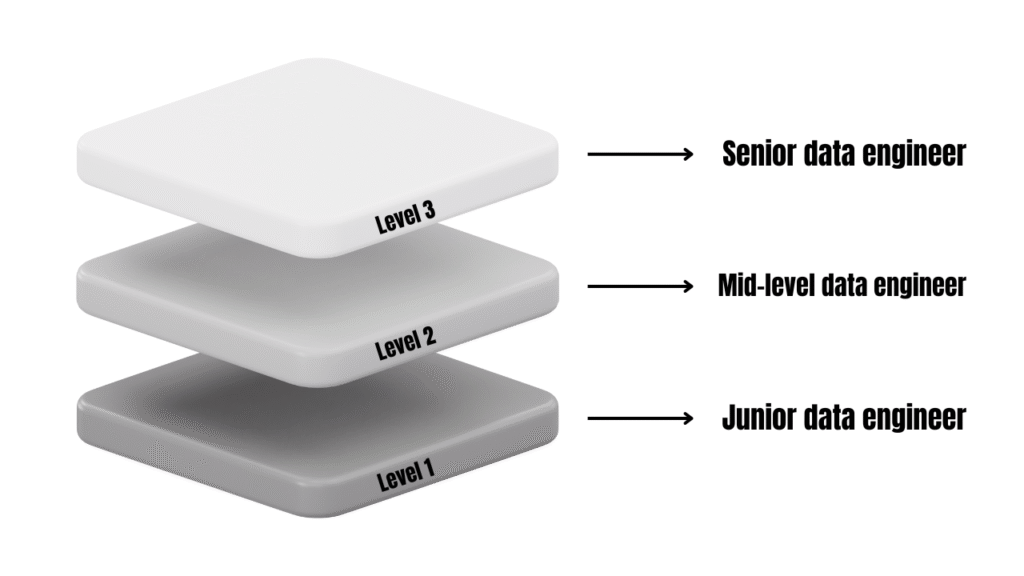
Level 1: Junior data engineer
This is the start of your career in data engineering. At this level, you’re learning how data engineering works in the real world. Things are messy. You’re in an expectation vs reality phase.
Your job right now is to understand the data environment of your organisation and not make it worse. You’ll mostly be working on existing pipelines. That means fixing small issues, extending logic, and making sure data keeps flowing without surprises. You’re not expected to redesign systems or make big calls yet.
Level 2: Mid-level data engineer
This is where your job levels up in technicality. You’re no longer just fixing bits and pieces. You’re expected to own things. Pipelines, datasets, sometimes entire domains. When something breaks, people turn to you because either you can fix it or you own it.
You’re good enough to be relied on, so work keeps piling up. Ad-hoc requests, last-minute fixes, “quick changes” that aren’t quick at all. Suddenly, you’re busy all the time but not really progressing.
The key skill here is learning when to push back calmly, with reasons, instead of saying yes to everything.
Also read: How to get promoted in tech and data: Realistic 3-step guide
Level 3: Senior data engineer
By the time you’re senior, your value sits in the decisions you make, not the amount of work you push out.
A senior data engineer spends a lot of time thinking before touching anything. You’re trusted to choose sensible approaches, avoid unnecessary complexity, and make calls that still hold up months later. People rely on your judgment because it saves time and rework.
People now turn to you for advice and opinions; they value your choices. Your influence also extends beyond your own work. You mentor juniors without formally being asked. You standardise patterns so the same mistakes don’t keep happening.
Parallel tracks to go instead of climbing the data engineering career ladder
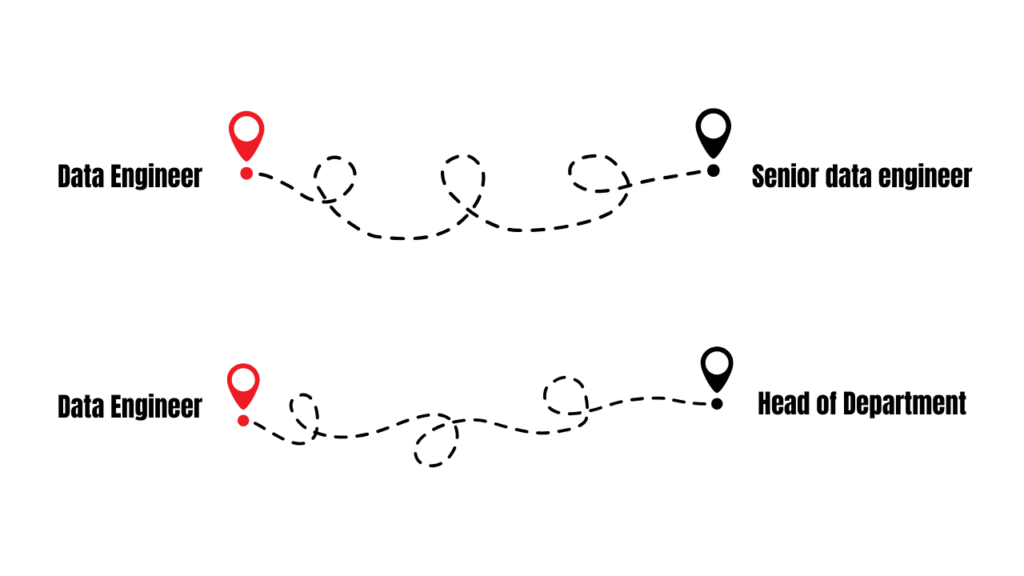
Till now, we have discussed the linear career progression of a data engineer. But not everyone wants to climb the ladder. Career growth doesn’t always mean junior, mid-level and senior. You can also step into peripheral domains.
One track is deep technical expertise. You can become the go-to person for data architecture, DevOps, pipeline performance, or large-scale infrastructure. Another track is team leadership and management.
Also read: Technical vs management career path: Which is better for you
The point is: growth doesn’t have to be linear. You can go wider or deeper, as long as you’re intentional about what skills you’re building and where you want to progress.
Career transitions data engineers commonly make
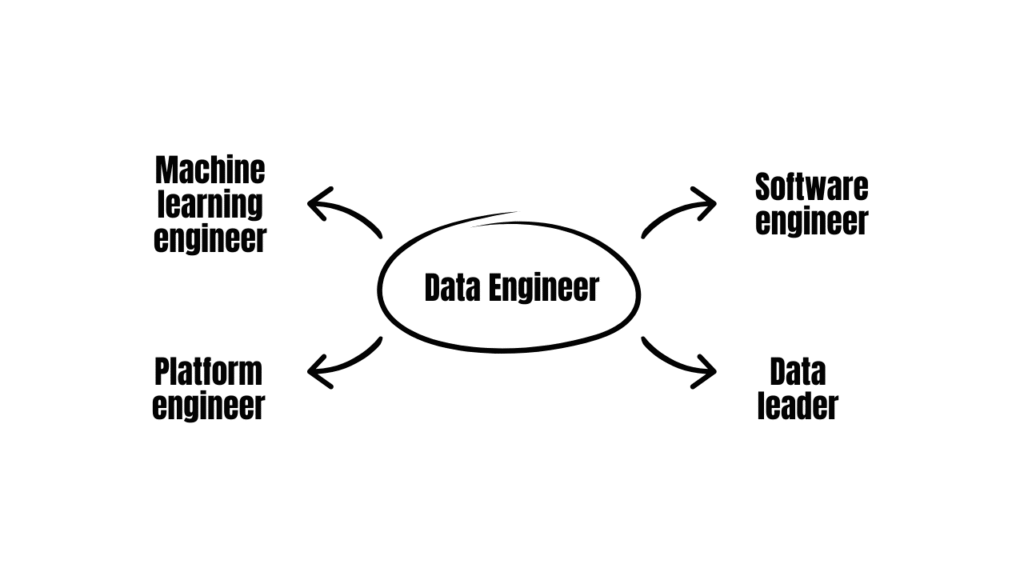
Machine learning engineer
This path suits people drawn to modelling, prediction, or deploying ML systems. You’ll usually need some statistics, ML knowledge, and experience with pipelines that serve models rather than reports.
It’s a good fit if you enjoy applying engineering skills to make intelligent systems that learn and improve.

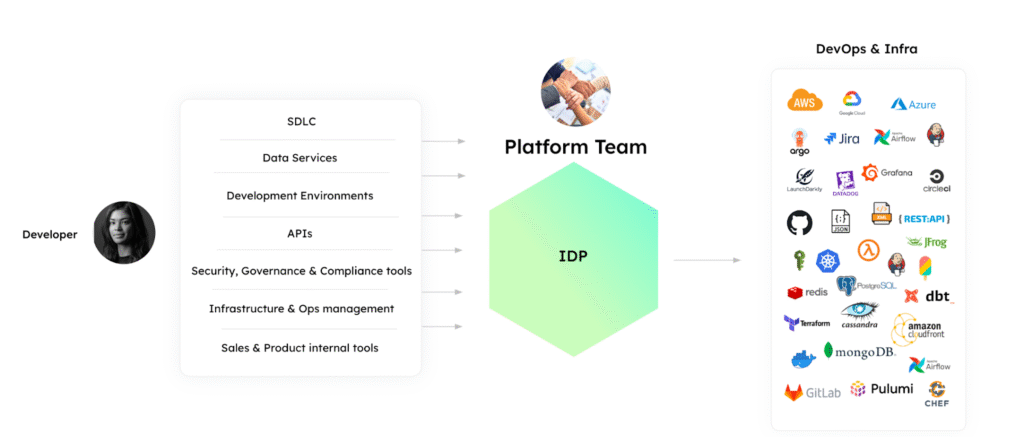
Platform engineer
If you like building tools for other engineers and making things reliable, scalable, and easy to extend, platform engineering could be for you. You’ll spend time thinking about automation, monitoring, and frameworks that help others move faster.
Software engineer
If you enjoy writing complex systems, solving tricky bugs, and building scalable software, this path might suit you. It’s a bigger transition than the rest, but it’s worth it for the right person.
You’ll be writing more code than before. You might work on APIs, backend services, or large-scale systems that support data platforms and applications.
Data leader
If working with people excites you more than the tech itself, moving toward a data lead or engineering manager role is valid. You’ll spend more time mentoring, planning, and resolving conflicts than writing code. This is a shift from an individual contributor to a team-player role.
Your day-to-day will look something like this: You’ll guide teams, help others make better technical decisions, and shape data strategy across the company. Your day will be filled with meetings. You’ll be the connection between your teams and stakeholders.
If you’re inclined towards leadership, Foundations of Leadership for Nerds will be your best friend, equipping you with the right mindset, concepts, and frameworks to confidently and successfully step into leadership.

How to decide your next move?
Firstly, I want to make one thing clear. If you’re at the start of your career, do not try to figure it all out at this point because you won’t be able to do so correctly.
When you spend some time in the industry, you start to pick up pointers on what you like, what you’re good at, what you enjoy doing and what you absolutely hate. And these titbits help you decide your next move.
So, anyone who’s been in the industry for a while and has some clue about their priorities and interests, keep reading.
Start by asking yourself a few simple questions:
- Do you enjoy writing code every day, or do you get satisfaction from guiding systems and people?
- Do you like tackling detailed technical problems or solving broader organisational challenges?
- And do you prefer clarity and structure, or ambiguity and influence?
Pay attention to the patterns in your work that make you feel engaged and effective. If you love coding and optimising pipelines, a deep technical path might suit you. If you enjoy mentoring, system design, and decisions that impact multiple teams, leadership or staff-level work could be a better fit.
And don’t ignore the environment. Some companies reward specialists, some reward generalists, and some reward managers. Knowing which culture you’re in will help you avoid frustration and choose a path where your work is valued.
Also read: How to become a tech lead?
Keep moving, keep learning
Titles and levels are nice, but they’re not the point. What matters is knowing what excites you, where you add real value, and how you want your career to feel day-to-day. Follow the path that fits you, experiment a little, and don’t be afraid to take the leap; that’s how careers actually take off.
And if you made the wrong decision or you later figured you don’t want this, you can always go back. Your options are always open.
Learn more about Foundations of Leadership for Nerds.







![How to use AI in spend analytics? [5 use cases]](https://feriotti.com/wp-content/uploads/2026/04/1-3.png)