98.8% of businesses say ERP improved their processes. (The 2025 ERP Report by Panorama Consulting Group)
Yet most growing companies still try to scale on spreadsheets, scattered tools, and back-and-forth messages that quietly slow everything down. Growth feels exciting on the front end, but behind the scenes become a mess.
In this article, you’ll see exactly how ERP helps businesses by bringing structure to that chaos, connecting your departments, improving cash flow, and helping you scale without losing control.
What is ERP?
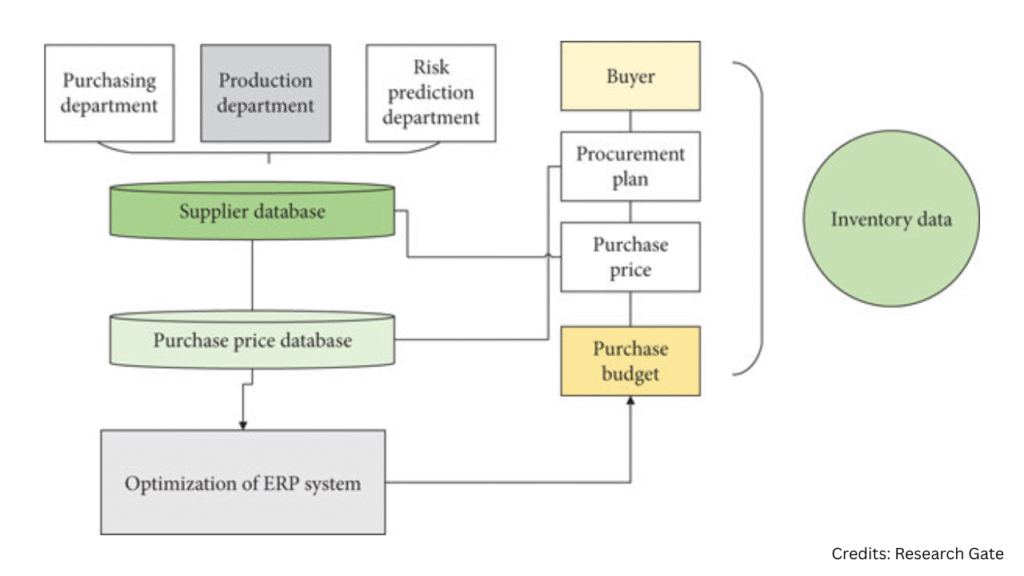
ERP stands for Enterprise Resource Planning. It’s a system that syncs all your business processes across all your departments. Think of it as a central, unified software system that connects and manages HR, Finance, Marketing, Logistics, Production, Supply Chain, and any other departments you may have.
Instead of managing your entire business on spreadsheets or having separate software for accounts, inventory, HR and marketing, you get one integrated system. Everyone accesses the same data and works in the same software environment that’s connected across departments, making collaboration straightforward.
A few popular ERPS you might heard of: NetSuite, Odoo, Oracle, and SAP Business One.
Let’s go through a real example to see how ERP helps businesses.
Why you need ERP [Explained through an example]
Let’s say you run a fashion brand. You start with four products and sell through social media and Shopify. At the beginning:
- You use spreadsheets to track orders
- Manually count inventory
- An accounting software manages your finances
- Your communication with manufacturers and vendors is through WhatsApp or email.
Everything seems smooth until your business starts to grow. You get more customers, the demand increases, and you launch new products.
At the customer front, it’s all fun and games. The graphs are going up, the sales are coming in, and the business is growing. However, the back office is a hell lot of a mess.
- Spreadsheets become unmanageable
- The finance team is reconciling numbers for days
- The cross-departmental communication is inefficient
- People wait for others for information, causing delays.
You can hide this chaos at the start, but it swiftly gets out of hand. And when that happens, it starts to reflect on the front end of your business. Overselling out-of-stock items, delayed production, unmanaged inventory, no real-time profit visibility, and dispatch errors are just a few things that could go wrong.
How ERP helps businesses
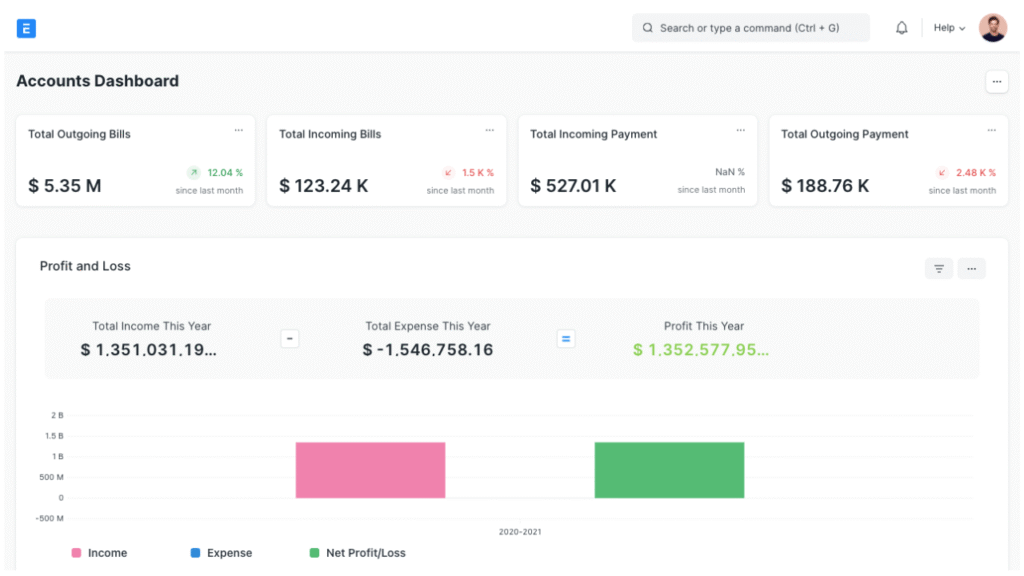
Once you have an ERP in place. This is what you can expect.
Let’s say you receive a total order of 150 hoodies during a sale. As soon as the orders are received, the system automatically reduces the available stock.
If there’s not enough stock, the system flags the shortage and creates a production request. If fabric is running low, it alerts the team to reorder it. At the same time, the sale is recorded in the finance module, and the warehouse receives a notification to pack and ship the order.
Without ERP, this would’ve required manual stock checks, spreadsheet updates, and back-and-forth communication that would’ve halted the process. But now your teams are at work right away.
With ERP, this efficiency and automation extend across every business process, whether it’s onboarding a new employee, payroll, marketing results, profits, revenues and whatnot.
5 key business benefits of ERP
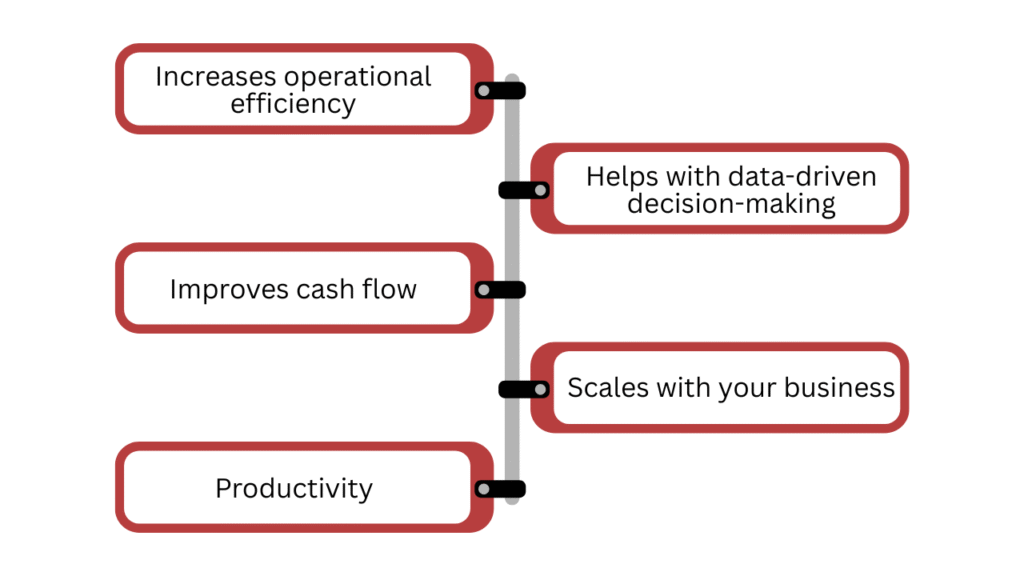
1. Increases operational efficiency
When HR marks a new employee as “hired,” the ERP automatically triggers payroll setup, creates user access credentials, and notifies IT and the manager. This automation eliminates paperwork delays and reduces onboarding time.
You get this level of efficiency in every business process of every department. Your work flows without manual intervention. No separate data entries in different software, no approval delays, and no miscommunication.
2. Helps with data-driven decision-making
Since ERP centralises all your business data, all information lives in one place, giving leaders real-time insights into every department and a bird’s eye view of the entire business.
For example, a manager can see current inventory levels, pending orders, and cash flow simultaneously, allowing them to decide whether to push a promotion, reorder stock, or delay a purchase.
3. Improves cash flow
ERP ensures money moves smoothly through your business. When an order is completed, the system automatically generates the invoice, tracks payments, and even sends reminders for overdue accounts. No manual follow-ups and reminders required.
It even gives you a real-time picture of your cash position and predicts future cash needs based on sales trends, outstanding invoices, and inventory commitments. This allows you to plan and allocate better, and with data-backed insights.
4. Scales with your business
One of the biggest advantages of an ERP system is its ability to grow with your company. Modular design allows you to add new functions like HR, CRM, or production management only when you need them, so you’re not paying for unnecessary features upfront.
Cloud-based ERP solutions further simplify scaling. And the 2025 ERP Report by Panorama Consulting Group mentions that 75% of the companies use Cloud-based ERPs. They let you access your system anywhere, anytime, without costly server upgrades or IT headaches. It’s the best solution for remote teams or businesses expanding across multiple locations.
You can manage multi-branch operations, handle different currencies, and even support multiple languages, all from a single platform.
5. Productivity
81.8% of respondents in the 2025 ERP Report by Panorama Consulting Group achieved the expected productivity and efficiency results.
When manual follow-ups, inefficient processes, and poor communication among departments are sorted, you get a surge in productivity.
Everyone can see the status of orders, inventory, or approvals in real time; no one is asking for updates or digging through spreadsheets to figure out processes. This not only saves hours every week but also keeps work flowing smoothly, letting employees focus on tasks that actually drive results rather than busywork.
Final thoughts: How ERP helps businesses
If your operations feel heavier as your sales increase, you have a systems problem that can be solved with a centralised management system like ERP. It gives you clarity, coordination, and confidence to scale. Because no matter how strong your foundations are, growth demands structure and systematic coordination.


![7 Practical ways to better use AI in CRM [ CTO’s guide]](https://feriotti.com/wp-content/uploads/2026/02/1-3.png)