
You know that moment in a meeting when you’re explaining something and catch that look? The slow nod, the polite smile, the eyes saying, “I have no idea what you said.”
Suddenly, you’re stuck in follow-up emails and more meetings, even though your explanation made perfect sense to you. Your brain is wired for precision, logic, and systems. You think in layers that most people don’t even know exist.
But communicating it and making sure the audience understands is your responsibility. And this article will help you translate your expertise into a language everyone can understand.
Whether you’re an engineer, a tech lead, or an engineering leader, if you belong to the tech space, then this is your guide on communication for engineers that will make people actually understand you the first time you speak.
Why you need to care about communication (even if you’re not in leadership)
It’s apparent that leaders communicate with cross-functional leaders and stakeholders and need to be able to break down complex ideas into simple terms.
But why, as an engineer, do you need to be careful of your communication?
Your communication skills lay the foundation for potential promotions and career growth. It helps you build relationships across functions, making it easier to collaborate and influence. As a result, you become the go-to person for breaking down complex ideas into clear, easy-to-understand concepts, which will bring you visibility and goodwill, aiding you in promotions.
How to get promoted in tech and data: A realistic 3-step guide
Communication for engineers: 9 practical tips
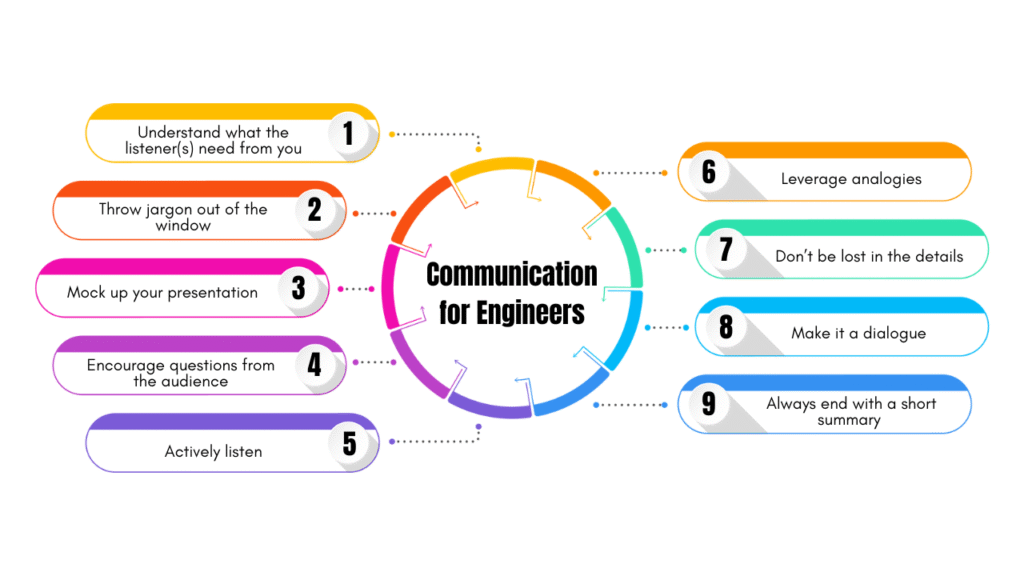
1. Understand what the listener(s) need from you
A tale that’s funny to children will be boring for adults. What you say is only as good as it is relevant to the listeners. What’s insight for logistics will be irrelevant to accounts and marketing.
So, before you embellish your speaking skills, you need to be aware of
- who your audience is,
- what they need from you,
- what they know,
- and what they don’t know.
If you’re presenting in a meeting, know who will be attending so you can set your base accordingly. A good way to do this is to have every attendee’s name, department, and needs in a document. Only knowing the departments and the hierarchy of attendees will also do the job.
2. Throw jargon out of the window
This one’s self-evident but still needs a dedicated place on this list. Unless you’re communicating with someone at the same technical level as you, jargon and technical terms should be limited or dropped completely.
Talking to logistics staff versus a tech colleague from another domain require a different level of terminology. The first group will need almost no technical terms, while the second can handle much more.
However, be careful, as someone who comes from a different tech background and domain will not be completely familiar with your tech terms. Or when certain terminology is essential to use, a good rule is to always give a one-line explanation. It gives context and makes it so much easier for the listeners to grasp the message.

3. Mock up your presentation
If you’re presenting to a non-tech audience, run a pilot test by presenting your part to a non-tech colleague. Ask for their feedback.
- How much did they understand?
- What areas did they find difficult to understand?
- Were there any unclear parts?
Ask them for a summary to see if they understood everything correctly. If they got everything right, that’s a double confirmation that your presentation has hit the mark.
4. Encourage questions from the audience
Wouldn’t all this communication be as easy as running code with zero dependencies if the audience told you right away when you lost them?
It’s possible if the audience asks for clarification right away. However, oftentimes, people stay quiet because confusion and lack of clarity feel safer than the fear of asking and coming across as dumb.
Your job as a presenter is to ensure that your audience understands that their questions are valuable and will be fully entertained.
- Lay the foundation at the start by explicitly saying that questions are welcome and appreciated.
- After a key point, pause and invite questions before moving on.
- Say things like, “If anything I say isn’t clear, please stop me. Your questions help everyone.”
- Prompt the audience with questions like, “Does this make sense to anyone from [department]?”
- Thank the person asking and answer without judgment to create a safe environment.
- Repeat and reframe the question in simple terms to ensure everyone benefits.

5. Actively listen
When you give your audience a chance to speak, make sure you’re actively listening to them and understanding where they’re coming from. This is the only way to know what they are finding difficult to follow.
Another important point, and a basic courtesy: never interrupt anyone while they’re speaking. Even if you’ve understood their point, let them finish.
6. Leverage analogies
When you ask ChatGPT to explain something like you’re a 5-year-old, it gives you analogies. You can do that too. Tech concepts are difficult to grasp, and analogies really help.
Find something that is general knowledge, or you know your audience knows about it and drive your analogy from there. ChatGPT or any AI is also a great way to find metaphors and analogies.

7. Don’t be lost in the details
Too much detail is as bad as too little context. It’s easy to get lost in a sea of details when we talk about our work, especially if we’re excited about it. But the extra details are a distraction for the audience. It draws them away from what’s important and makes a complex concept more difficult to understand.
So when you’re preparing a presentation or communicating in real-time, ask yourself: Is this important for the listener(s) to know?
8. Make it a dialogue
Call it an interactive session, two-way communication or whatever you want, but if you are explaining a super technical concept to a non-tech person, go back and forth with them on the subject.
Ask questions like
- What are you struggling to understand?
- Revise for me what you’ve understood.
- Does that make sense?
- Let’s summarise.
This dialogue will make it easier for you to catch your audience before you fully lose them. Plus, when people frame ideas in their own words, they remember them better

9. Always end with a short summary
Always wrap up by repeating the key points so your audience leaves with clarity. Keep it short and focused, just the crux, no extra details. This reinforces understanding and makes your message stick.
Final thoughts: Communication for Engineers
Hope you found this article helpful. Remember to apply one thing at a time, strategically. If you feel stuck, ask for guidance from a senior or a colleague who’s good with communication. You can also discuss it with your manager; they might arrange coaching or mentorship for you.

![7 Practical ways to better use AI in CRM [ CTO’s guide]](https://feriotti.com/wp-content/uploads/2026/02/1-3.png)