Think of the data industry as one giant bubble, and inside it, every role with the word “data” in its title seems to blur together. Data analysts and data scientists are all merged, mixed up, and used interchangeably. You can see the reflection of that confusion everywhere: in job postings, in actual roles, even in how companies talk about their data teams.
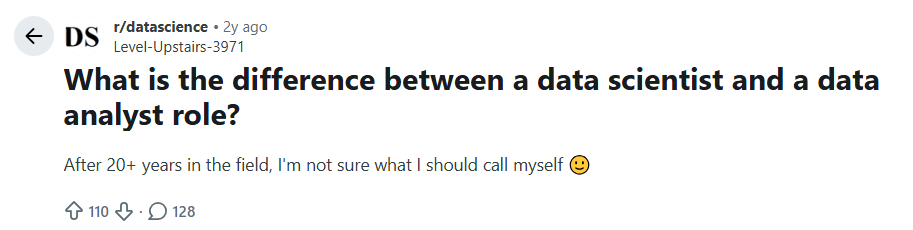
The confusion seems to be so deeply rooted that a Reddit user asked about the difference between a data scientist and a data analyst role after spending 20+ years in the data industry.
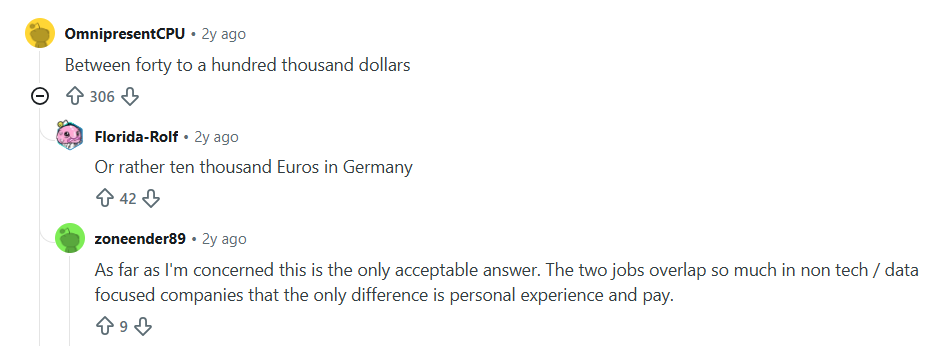
Funny that the audience also seemed to be confused. Some stated the difference in roles and responsibilities of the two titles, while others argued that the difference is only in salary and that the roles are highly mixed up.
Data analyst VS Data scientist
Let’s start with the major differences that set data analysts and data scientists apart.
Who is a data analyst?
A data analyst is the person who digs into the numbers to figure out what’s really going on inside a business. Their domain is “what happened” and “why”.
They gather the data the company already collects, clean it up, and turn it into meaningful insights that help leaders make better decisions.
Role and responsibilities
- Collect and clean data: remove errors, duplicates, and inconsistencies.
- Analyse trends and patterns: find out what’s working and what’s not.
- Translate numbers into stories: turn raw data into reports and dashboards that anyone can understand.
- Support decisions with evidence: help teams and leaders make informed business calls.
Who is a data scientist?
The data scientists work on what will happen next. They use data, advanced math, programming, and machine learning to predict the future or uncover insights that aren’t obvious.
For example, a data scientist can use patient data to predict the likelihood of hospital readmission after discharge, or they might design fraud detection algorithms that monitor thousands of transactions every second. They train machine learning models on past transaction data to recognise patterns: what a normal transaction looks like versus a suspicious one.
Role and responsibilities
- Gather and explore data: work with massive datasets from different sources.
- Build models and algorithms: use machine learning to predict outcomes or detect patterns.
- Experiment and test hypotheses: fine-tune models until they perform well in the real world.
- Develop data-driven solutions: from recommendation engines to fraud detection systems.
Technical skills
Data analysts typically focus on:
- SQL and Excel for querying and analysis.
- Data visualisation tools (Tableau, Power BI, Looker).
- Basic Python or R for data manipulation.
- Descriptive statistics and business reporting.
Data scientists go deeper with:
- Advanced programming in Python or R.
- Machine learning frameworks (TensorFlow, Scikit-learn, PyTorch).
- Data wrangling with Pandas, NumPy, and Spark.
- Statistical modelling, hypothesis testing, and data pipelines.
- Cloud platforms (AWS, GCP, Azure) for model deployment.
Software and tools
Data analysts mainly use the following tools:
- Data cleaning and analysis: Excel, SQL, Google Sheets
- Visualisation and reporting: Power BI, Tableau, Looker, Google Data Studio
- Basic scripting: Python (Pandas, Matplotlib) or R for light analysis
- Database management: MySQL, PostgreSQL, Snowflake
Data scientists work with:
- Programming and modelling: Python, R, and notebooks like Jupyter or Colab
- Machine learning and AI: TensorFlow, Scikit-learn, PyTorch, XGBoost
- Data handling: Pandas, NumPy, Spark, Hadoop for large-scale data
- Visualisation: Matplotlib, Seaborn, Plotly, Dash
- Deployment and cloud: AWS SageMaker, Google Cloud ML, Azure ML
Business impact and decision-making role
Data analysts support operational and tactical decisions like improving marketing ROI, tracking product performance, or optimising workflows.
Data scientists contribute to strategic, forward-looking initiatives like building recommendation systems, predictive maintenance tools, or fraud detection algorithms.
One guides and shapes the current business strategies and processes, the other guides the future game plan.
The reason why the roles are confused: Similarities between a data analyst and a data scientist
Despite the difference in scope and technical depth, both roles share the same foundation and similar skills and tools, which is why non-tech companies often confuse them.
Both start with raw information that’s often incomplete or messy and transform it into something useful through cleaning, validation, and structuring.
At the core, both roles require a strong analytical mindset and rely on statistical reasoning, logic, and curiosity to make sense of complex information. The tools they use are also similar. SQL and Python are almost universal languages across data teams, while visualisation platforms like Power BI, Tableau, or Looker help them communicate insights effectively.
Another key similarity is how they both come across to non-data teams. They translate the data into insights that stakeholders can act on. To non-tech peers, both roles can look similar as they use storytelling to do that.
So in a nutshell, to a non-data person, the roles can look similar on the surface.
Also Read: Data Analyst Career Progression
Data analyst VS Data scientist: Final say of a data pro
Call them what you want: analysts, scientists, data nerds. At the end of the day, we’re all just trying to make sense of the mess and turn it into something useful. The difference? Some of us look back, some look ahead. But the real flex is knowing how to make data actually matter.

![7 Practical ways to better use AI in CRM [ CTO’s guide]](https://feriotti.com/wp-content/uploads/2026/02/1-3.png)