Do you know why every organization conducts more than five changes every three years?
The answer is straightforward: to get ahead of the race. However, the data suggest a surprising perspective. More than 60% such changes fail, resulting in stalled growth.
The reason why these changes fail is ineffective change management: professionals prefer intuition over data. Insights are often overlooked, and impulsive decisions are made. Team loses direction between “what we assume” and “what we know”.
That’s where data proves to be the deciding factor. When used strategically, analytics guide the process and predict the outcomes. It replaces the guesswork with a clear roadmap.
This blog breaks down how successful change management is led by analytics for data professionals who aim to move into leadership roles.
What is Change Management? And Why Does Successful Change Management Require Data?
The process of preparation, strategy, and execution for any organizational transition is change management. Whether it’s a new workflow, an improved system, or setting goals. It’s a foundation to align resources, teams, and processes towards future goals.

Here’s how a traditional change management process is conducted. Leaders combine experience, intuition, and convenience, ignoring insights. Designing a new workflow for teams: X task is automated and Y process is replaced. Rationale: AI must be implemented for automation/processes as AI has taken over, and we will be left behind.
Result: Another initiative making its place in the 60% failed attempts.
Here’s how data-driven change management is implemented. Professionals combine the traditional approach with measurable insights. Improving the team workflow: X processes are redesigned, and Y tasks are automated. Rationale: Data showed that the previous process resulted in a 40% lower growth rate than the new one. And Y tasks required more than 30% of employees’ working hours.
Result: Successful change management has made its place in 34% effective initiatives.
How to Use Analytics for Data-Driven Change Management?
Measurable insights play an important part in shaping the next initiative. As a data professional, insights help you gain clarity on what’s working, what to focus on next, and what’s not yielding results. But using analytics must be approached strategically.
Below is a four-step framework for data professionals to effectively use data as a foundation for change:
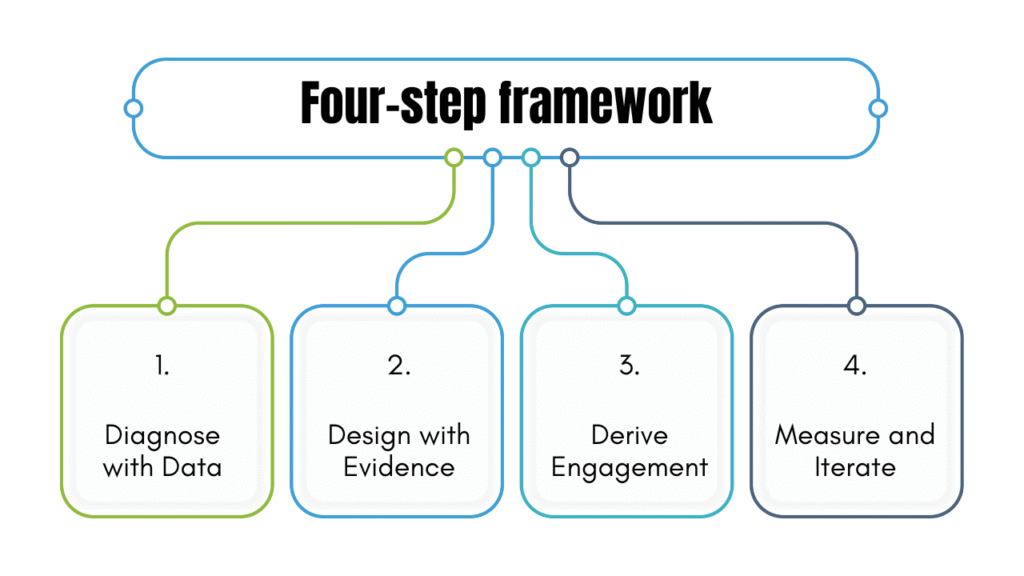
1- Diagnose with Data
Understand the problem based on the analytics. Don’t rush into planning or strategy before having a closer look at the available insights. Identify the root cause and decide based on the statistics.
If you’re planning to revisit business goals, analyse the previous results yielded by the current targets. Compare them with the records and see where the problem lies.
Track the department’s performance data to see which department is lagging in yielding the desired results. Is it a lack of resources or internal miscommunication affecting the results?
2- Design with Evidence
After identifying the cause, design a solution with evidence, not assumptions. Jot down potential risks, expected outcomes, and set key performance metrics. This helps design a laser-focused approach.
Test your assumptions with a scenario or approach analysis, and use predictive models to forecast the expected results. Analyse the compatibility of the solution with current processes.
If a department needs a new tool for internal workflow, assess the budget for setting up the tool, the time required to transition from the current tool to the new and how this will affect the performance of the team.
3- Derive Engagement with Dashboards
Use the data visualization for a collaborative approach rather than a pretty screen. Use dashboards and tools to share real-time insights with others. Pin the problem, propose a solution, and keep everyone informed of the change ahead.
When you share your real-time assessment with the team, stakeholders, and collaborators, the change becomes more acceptable. Trust grows, and everyone stays aligned with the shared goals.
4- Measure and Iterate
Once you’ve finalized the initiative, set up the change measurement process. The best change management goes through several iterations before hitting targets.
Create a set of indicators to analyse the step-by-step performance of the solution. Use a combination of both qualitative and quantitative performance metrics.
This creates a functional, continuous feedback loop where every metric is measured. Team can see the progress and iterate regularly based on the feedback.
Role of Data Leadership for Successful Management
Learning the strategies, getting the experience, and implementing the insights isn’t always a guarantee of success. A Harvard Study reveals ineffective leadership is one of the potent reasons why change management fails. Leaders miscommunicate or create a mismatched approach for teams.
Picture this: You’ve followed the best practices of change management, used analytics for insights, and created a perfect plan to execute the initiative. Still, it failed badly. Lack of clear communication, solution-team culture mismatch, and poor documentation are culprits.
As a data professional transitioning into a leadership role, it’s not just about utilizing data or technical skills. It comes down to having an impactful impression. For example, don’t ask yourself “what does the data say?” Instead, focus on “ how do these analytics drive alignment and results?”.
Resources and Tools for Data-Driven Change
Data Leadership requires more than just leading through data. Structures and the right resources help command authority and clarity. Once you master the technical skills, it’s time to upgrade with impact. Here are a few resources designed to master data leadership and effective analytics-led change:
KPIs and Framework
Keep track of the performance through set indicators using proven frameworks. This helps collect data into a more refined collection, resulting in effective change. You can use different templates catered to data-driven leaders.
They’re designed to help you:
- Effectively use analytics
- Align teams and stakeholders
- Track KPIs in real time
Mentorship Programs
It is an often-observed fact that leaders get confused in navigating the process. The data suggest one direction, and the experience hints at another approach. Missed direction and alignment are the results. If you’re a data leader or transitioning into a similar role, a mentorship program can act as a guide.

Final Words
Successful change management is a combination of data-driven strategy and impactful leadership. Strong analytical assessment is necessary with a traditional change management approach. Use the real-time data, decide based on the metrics, measure the outcomes, and always iterate early.

![7 Practical ways to better use AI in CRM [ CTO’s guide]](https://feriotti.com/wp-content/uploads/2026/02/1-3.png)