
You’re good at your job: shipping features, fixing bugs, keeping things running. But moving up to a tech lead? That feels like a whole different ballgame. How do you get there? And why does it seem like everyone else already has the playbook?
If you’ve ever thought, “I’m ready for more, but I don’t know where to start,” this guide is for you: a practical and straightforward guide to help you become a tech lead.
What a Tech Lead Really Does
The definition of “tech lead” isn’t universal. Different companies see this role differently. In some teams, a tech lead writes a lot of code. In others, they barely touch code and spend most of their time guiding people, shaping architecture, or acting as the bridge between engineering and the business.
But at its core, a tech lead is a blend of technical expertise and leadership. It’s not a promotion where you stop coding. It’s a role where your impact shifts from “my work” to “the team’s work.”
A tech lead is someone who:
- Makes technical decisions and sets the direction.
- Ensures the team follows good engineering practices.
- Helps team members unblock themselves and grow.
- Connects the dots between product goals and technical execution.
- Communicates with managers, designers, PMs, and other teams.
- Keeps an eye on deadlines, risks, and quality.
Also read: What new tech and data leader should do first?
How to become a Tech Lead
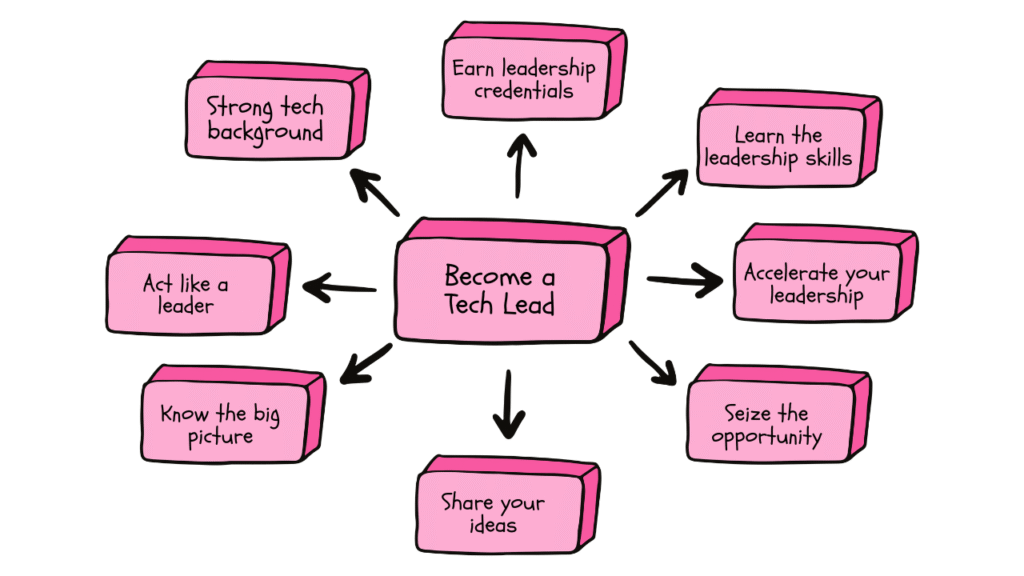
Strong tech background
Before becoming a tech lead, you’ll likely be an engineer, developer, or working in an individual contributor role. You already have a strong grasp of your technical expertise, tools, and domain, which is essential for stepping into a tech lead position. Your technical fundamentals and qualifications are mostly sorted at this point. If there are any gaps you can strengthen, do that now before moving on to the next steps.
Earn your leadership credentials
The next part of becoming a tech lead is “the lead” part. You can take a leadership course, join a management program, or enrol in any internal leadership training your company offers. This gives you an edge: you’ll not only understand how leadership works, but you’ll also position yourself as a stronger, more prepared candidate for the role.
Learn the leadership skills
A tech lead is ultimately a team player. The role requires managing and working with your own team, while also collaborating with other teams and departments to get things done. You’ll be dealing with people who have different strengths, weaknesses, backgrounds, and priorities, which is exactly where soft skills like communication, empathy, seeing the bigger picture, understanding the business, and managing people effectively become essential.
Your leadership training will help you build these skills, but you don’t have to wait until then. Here are 10 soft skills every leader should have, along with a realistic framework for learning each one.
Act like a leader: Leadership without title
“Don’t wait for the right moment to start, start and make each moment right.”
Roy T. Bennett
That’s exactly what we’re doing now. Once you’re familiar with the core leadership skills, start practising them in your day-to-day work. Notice how I said familiar, not expert or master. A basic understanding is enough to get you started, and you can learn the rest along the way. Because no matter how much you read about leadership, you won’t truly grasp it until you start living it.
Small actions can make a big difference in your learning and help you stand out as the ideal candidate for the role. Even if you’re not aiming for an internal promotion, these moments count as real, demonstrable leadership experience in interviews.
Here are 5 examples to lead without a title:
- Take ownership of small projects and volunteer to coordinate tasks across the team.
- Initiate a review or retrospective when you spot a recurring issue.
- Offer support to junior teammates: explain concepts or give constructive feedback.
- Communicate proactively: raise risks early, clarify requirements, and keep stakeholders updated.
- Improve team workflows by suggesting better tooling, documentation, or processes.
Know the big picture
Make it a habit to investigate the big picture. If you’re working on a project, you should understand the goal, how it ties back to the business, what the business benefit is, and why certain decisions are being made. If you’re missing context or can’t connect the puzzle pieces, ask your manager. Clarity is part of leadership.
Having this context will help you ask the right questions and offer better solutions and suggestions, which again reinforces your position as a potential tech lead.
Share your ideas and insights
Suggestions, opinions, solutions; we often keep these to ourselves, but we shouldn’t. If something feels off, ask for clarification. Got a question? Ask it. Have a suggestion? Pass it on.
Don’t be afraid to challenge decisions respectfully. You might help improve the outcome, or the explanation you receive will expand your knowledge and give you better context. Either way, you win.
Seize the opportunity
Lastly, have an open heart and the courage to embrace opportunities. Volunteer to lead a project, take ownership of a small initiative, or let your manager know you’re interested in becoming a tech lead.
Most people wait to be “picked.” But leaders raise their hands. When you actively step forward, you make it easier for others to see you in that role. Sometimes all it takes is one project, one conversation, or one moment of courage to shift your entire career path.
Also read: How to lead a team as a first-time manager in tech?
Accelerate your leadership journey
Patiently waiting for a promotion will never be a good idea. You have to actively make efforts to land it. And the best way to start this journey is to practice leadership without a title. Every conversation, every project, every decision and suggestion is a chance to showcase your leadership potential.
If you want to accelerate your journey to a tech lead and beyond, my 8-week mentorship program will guide you with real-world strategies, mindset shifts, personalised feedback, and the confidence to own your path. Learn more about it here.

![7 Practical ways to better use AI in CRM [ CTO’s guide]](https://feriotti.com/wp-content/uploads/2026/02/1-3.png)