
You’re doing great work, meeting deadlines, getting things done… and yet, your career feels stuck. You’re putting in the effort, but nothing seems to change. It’s frustrating, confusing, and honestly, it can feel demoralizing. And you are wondering how to get promoted in your field.
Here’s the thing: being good at your job alone isn’t enough. Promotions in tech aren’t handed out, they come to the people who make their impact visible, own their growth, and know how to play the game smart. This guide shows you exactly how to do that.
I’ve categorised the article into 3 steps to answer your question of how to get promoted in tech and data industry. Let’s get straight into it.
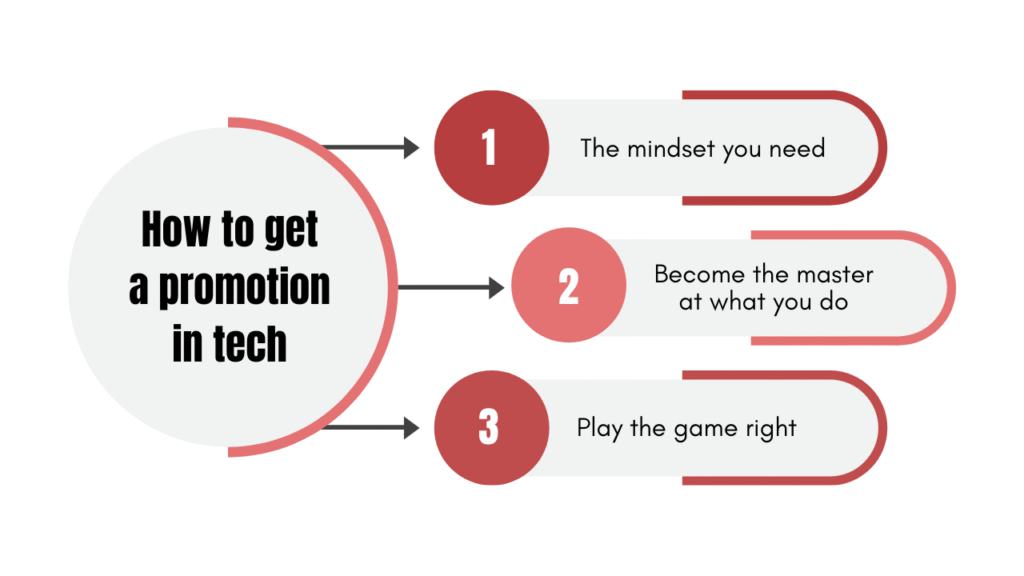
Step 1: The mindset you need
Understand that you need to make an active effort
The first thing you need to internalise is that promotion requires active effort. Your promotion is your responsibility, and your manager doesn’t owe you one.
If you think you will keep doing a great job and your boss will magically notice your hard work and potential, that’s not going to happen. Managers have a lot on their plates. They do not have the capacity to oversee every single team member and estimate who deserves a promotion.
It’s your promotion, and you need to put in the effort to secure it.
- Demonstrate the attributes required for the next role.
- Talk to your manager about your interest in moving up.
- Show them your work and, more importantly, the impact of that work.
- Work with them to understand the expectations for the next level.
- Identify your areas of improvement.
- Position yourself as the strongest possible candidate.
All of this requires stepping out of your comfort zone and taking intentional action.
Don’t cling to your current state
Most people don’t like hearing this because it triggers the fear that comes with leaving the cozy comfort state they’re in.
But the truth is simple: you need to let go of your current state if you want to grow and reach something better. Sometimes that means leaving a team, a department, or even an entire company. Growth takes effort, and change is rarely pleasant.
But if you’re stuck, overlooked, or hitting a ceiling in your current environment, change is the smarter move. For many, moving to a new company can be a smart way to advance faster and skip some of the usual steps in the career path.
So aim for internal growth. But if that’s not happening, don’t be afraid to find a new team or a new company where your potential is seen and rewarded.
Step 2: Become the master at what you do
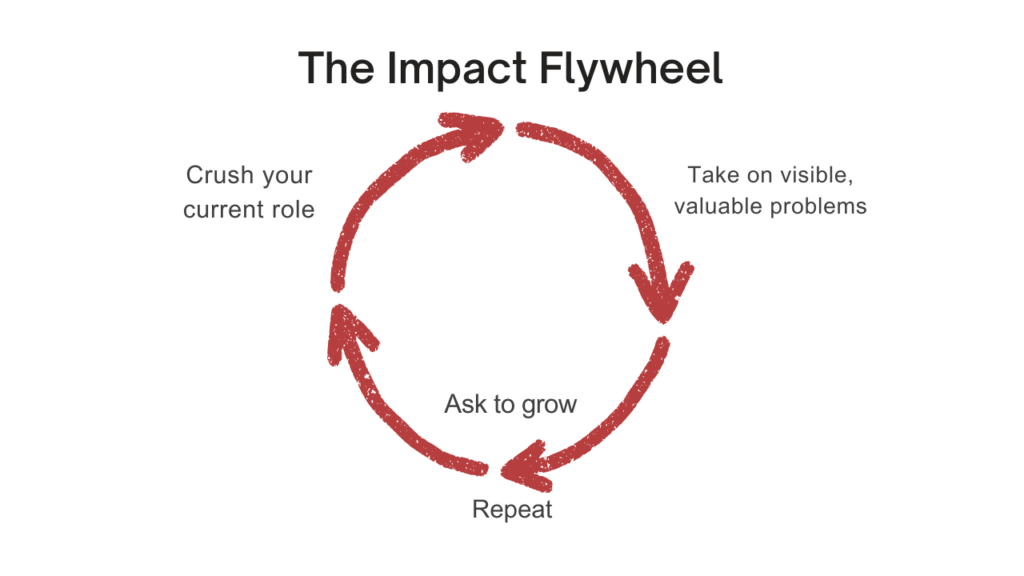
Once your mindset is set, the next step is simple: excel at your current role. This starts with becoming absolutely reliable in what you already do.
Before anyone considers you for the next level, you need to show consistent, high-quality work. That means knowing your tools, workflows, and responsibilities inside out. As you build this foundation, aim to deliver work that needs minimal corrections.
Over time, you become the person your team can depend on, and that credibility becomes your ticket for the next role.
Also read: Data engineer career ladder
Step 3: Play the game right
Understand the promotion process of your company
You need to know how your company evaluates growth. Every organization has its own criteria, timelines, and review cycles. In big tech, promotions come down to what a broader group thinks of your work. Your self-review, your peers’ feedback, and your manager’s summary get funneled into a calibration meeting, where multiple managers and senior engineers debate and vote on your rating.
Your company might have a simialr protocol or their own method of promotion. You should be aware of what metrics, skills, and behaviors are considered for advancement and who influences promotion decisions and how they are assessed.
Knowing this process will help you align your work, document achievements strategically, and position yourself effectively.
Document your work
Promotion demands showing your value through your work, and you can’t rely on memory for that. It’s all in the air if not documented. No matter how good your work is, if it’s not documented and presented clearly, it won’t have the impact it deserves.
Start capturing your work in a simple, ongoing log. Capture what you did, why it mattered, and the impact it created. Keep it factual and concise:
- problem,
- action,
- outcome.
This becomes your evidence when promotion discussions come up. It also aids your manager in advocating for you.
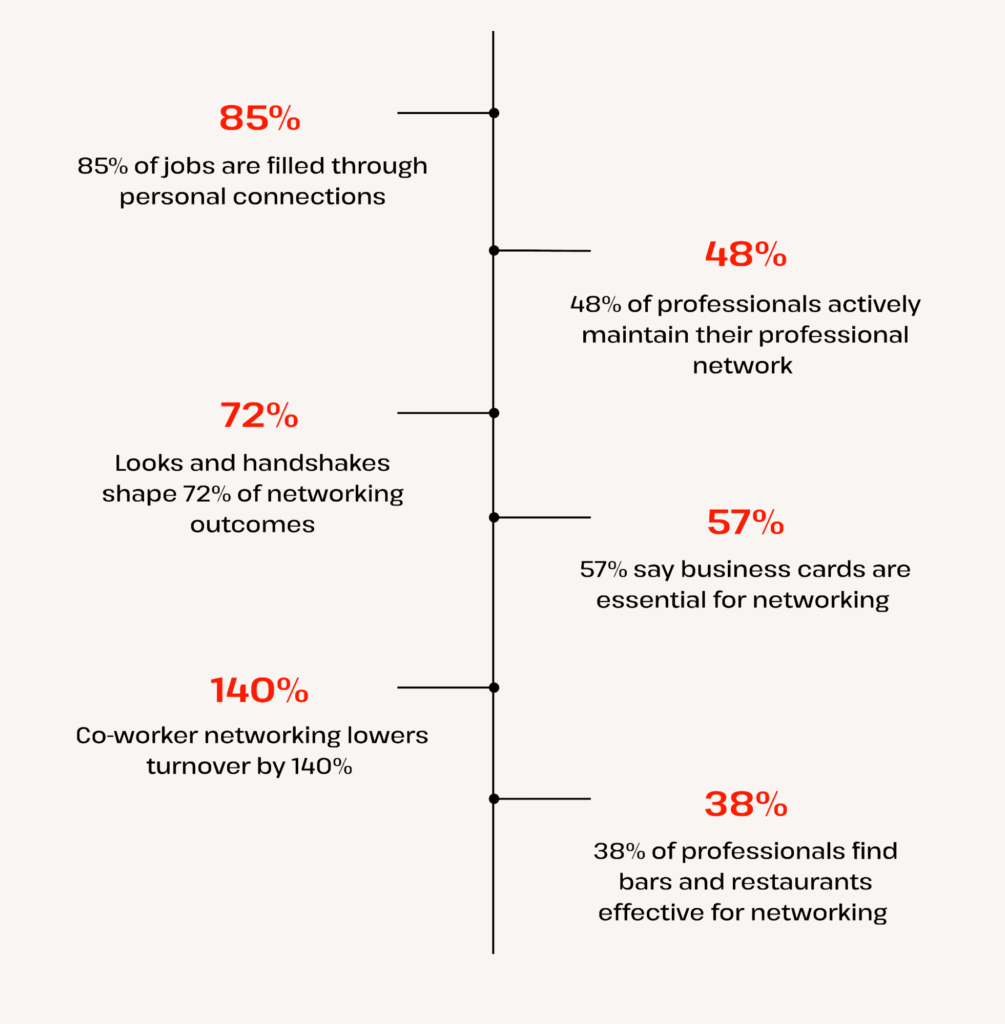
Connections and relations
The people you work with play a big role in how you’re perceived. When peers, cross-functional partners, and senior stakeholders genuinely respect you, it becomes much easier for your manager to advocate on your behalf.
So focus on being someone others enjoy working with. Collaborate well, communicate clearly, and follow through on what you promise. These relationships naturally become your strongest support system when promotion discussions start, because people are willing to vouch for the impact you’ve made.
Create value and impact
People who create visible value and impact have significantly higher chances of getting promoted than those who only mind their own business. Creating value shows that you’re elevating the team’s performance and contributing to outcomes that matter.
A suggestion, assistance, initiative, problem-solving, or idea; all count and create impact. Here are a few examples of how you can use these tiny gestures to create impact and value:
- Identify recurring problems and propose simple, practical fixes.
- Suggest improvements to workflows, documentation, or team processes.
- Share ideas that help the team save time, reduce errors, or work more efficiently.
- Step in to help teammates unblock issues or move a project forward.
Take small initiatives that show ownership, automation, templates, better reporting or anything that improves how the team operates.
Demonstrate the requirements of the next role
Your manager needs clear evidence that you’re ready for the next level. If your promotion is within the same technical track, your current performance and well-documented work will speak for themselves. But if you’re aiming for a different path, like moving into a managerial or leadership role, you’ll need to show proof of the specific skills required for that position.
It includes leading projects, mentoring teammates, or making strategic decisions that demonstrate readiness for the new responsibilities. In short, embody the skills required for the next role. Practice leadership without a title.
Learn 8 practical ways to practice leadership without title that positions you right for your promotion and makes your potential visible.
Fast-forward your promotion to ladership and managerial roles
If you’re ready to stop waiting and start stepping up, my 8-week mentorship program is designed for data and tech professionals like you who want to move into managerial and leadership roles.
Over eight weeks, you’ll get hands-on guidance, actionable strategies, and mindset shift that brings out the leader inside you. You’ll learn how to build influence, lead teams, make high-impact decisions, and position yourself as the obvious choice for promotion.
Learn more about leadership mentorship here.

![7 Practical ways to better use AI in CRM [ CTO’s guide]](https://feriotti.com/wp-content/uploads/2026/02/1-3.png)