Let me guess, if you have searched for leadership style in startups, hoping to find one or two best-suited styles to implement in your organisation, then you’re highly mistaken. Leadership in startups has a spectrum and is much more complex than corporate leadership.
In this article, we’ll explore all the complexities of startup leadership, why you cannot have a rigid leadership style in startups and how it is different from corporate leadership.
Leadership in startups: The backbone
Corporate settings and established companies have defined systems, processes and hierarchies. Their company culture is defined by the ecosystem they’ve built over the years.
Whereas startups have a totally different playbook. They have limited resources, high risk, and a small team. They do not have rigid structures, frameworks and super-specific hierarchies that define the company ecosystem.
Founders and leaders set the tone, direction and company culture, defining the very identity of the company. That’s the weight a startup leader carries. And on top of that, as the only constant in startups is change and uncertainty, leadership styles also need to evolve as the company progresses. You need a completely different approach for ideation and product development than you do when scaling your company. It’s messy, dynamic, and often unpredictable.
Leadership challenges in startups
Startups have their own unique challenges.
To start off, teams are small, and each person wears multiple hats. Unlike established companies, where the leader supervises and makes the company-wide strategies and is not involved in everyday tasks, in startups, there is no such defined boundary. The founder is the CEO, leader and manages day-to-day operations. It’s tricky to know when to wear your leadership hat.
Secondly, the leader defines the entire identity of the company, which can become a challenge. Your leadership directly influences your team’s motivation, their sense of purpose, decision-making, problem-solving and overall progress of the company. With a team so small, your leadership’s impact is amplified at every stage.
Lastly, the third big challenge for leadership in startups is balancing the dynamics. At every stage of startup, you need to adapt your leadership style, which can be tricky for a lot of people. Even within the same phase, you might need to focus on different aspects. Some days you need to be visionary, while on others you need to focus on execution or critical decision-making.
Leadership models for startup companies
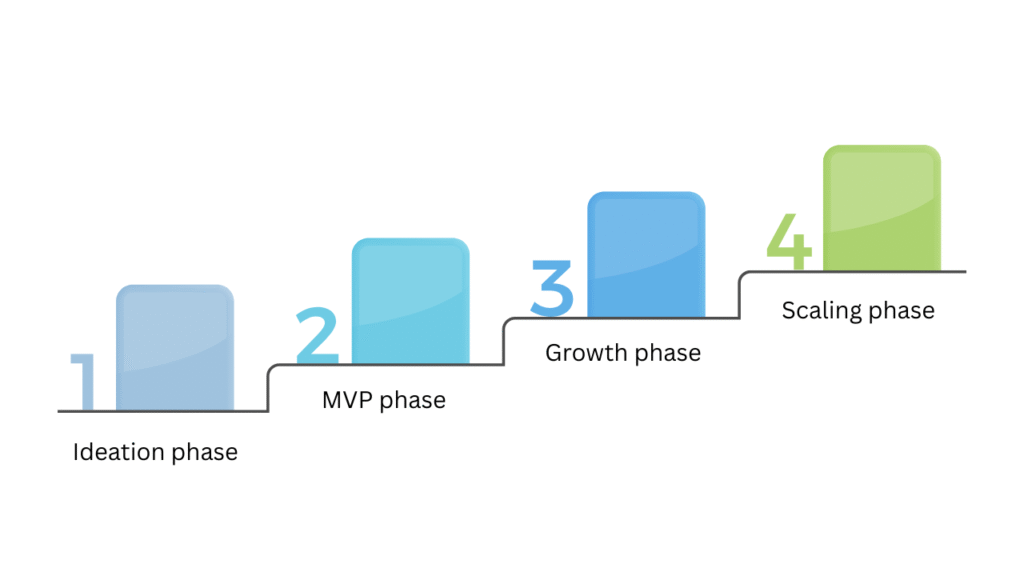
We have already established that leadership in startups isn’t constant. It evolves as the company progresses. Here’s a quick breakdown on what leadership model suits every stage of a startup. But before that, get yourself familiar with the 6 most common leadership styles, so you know the terms coming ahead.
Ideation phase
This is the pre-seed stage, when you’re defining the problem, validating your solutions, and raising your first-ever investment to formally start your business. At this stage, you either have a very small team or just the founding members. The style that the official or unofficial leader needs to take is visionary leadership.
You need to go all in on your vision and mission and gather your team around the problem you’re trying to solve. This will be the initial pull for the right people and keep the team motivated.
MVP phase
The next stage is to bring your solution into existence. Your team will be small but will consist of skilled members. You have clearly defined and communicated your vision, purpose, and the problem and the team is aligned with it. Keeping the vision alive, you need to pivot into a combo of servant and democratic leadership.
With such an exclusive team, every member becomes part of decision-making, every voice matters, and the collaboration shapes the final product. The leader works alongside the team, often wearing multiple hats and keeping their team morale high while focusing on the current objectives.
Growth phase
Consider it as your Series A funding stage, where you have tested out your MVP and are ready to scale it into a full-fledged product. You will need to expand your team and establish processes so the company runs smoothly. The main focus at this stage is building systems and processes.
Transformational leadership works the best at this stage. You need to grow the company while maintaining a healthy work environment and team coordination. Inspire the team to scale beyond the early hustle mindset and focus on the personal and professional growth of team members.
Also read: The best remote leadership model + 6 tips to manage remote teams.
Scaling phase
You’re now an established startup and want to scale into new markets. The scaling phase needs rapid execution. Your team will further expand to share the new workload.
You need to maintain the transformational style with a touch of autocratic leadership. Transformational leadership will inspire the new hires and keep them motivated, while the autocratic style ensures fast decision-making and rapid execution.
Take one thing out of this read
If you have to take one thing out of this article, it has to be this: Leadership style in a startup setting can’t be rigid. It has to evolve to suit the company and team’s needs at every stage.
This dynamic leadership style is also called adaptive leadership, where you adapt your style according to the situation at hand. Some days you’ll be the cheerleader, other days the tough decision-maker, and that’s exactly how you grow with your startup. Honestly? It’s messy and challenging, but it’s what makes building a startup so exciting.

![7 Practical ways to better use AI in CRM [ CTO’s guide]](https://feriotti.com/wp-content/uploads/2026/02/1-3.png)