You’re leading a big project, juggling deadlines, and in an interview, you’re asked how you handled it. Suddenly, you’re caught between oversharing details or leaving too much out. We’ve all felt that pressure. But fortunately, the STAR method is there to restore the balance.
By the end of this article, you will know how to tell clear, confident stories that showcase your leadership skills and leave a strong impression, all with the help of a four-letter word: STAR.
What is the STAR method?
The STAR method is one of the most popular ways of telling stories and sharing examples, pretty much in all areas of life, but particularly in interviews and cover letters.
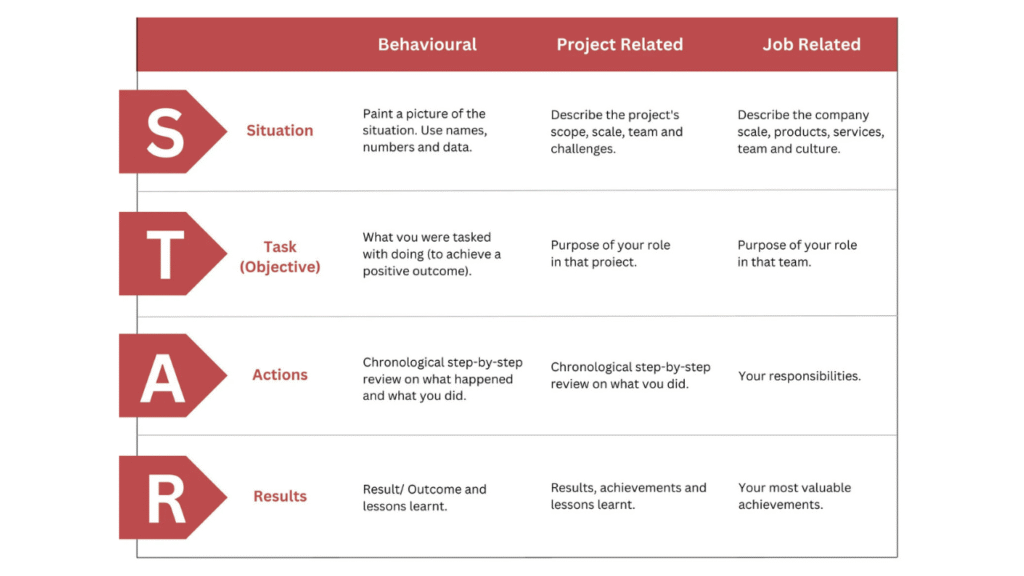
If you don’t know what the STAR method is, it stands for:
- S: Situation
- T: Task
- A: Action
- R: Result
You start with the background and context to set the stage, then clearly define the goal that needs to be achieved, then you dive into the actions you took, your strategy, and your struggles, and lastly wrap it up by addressing the result or impact of your efforts.
The major part of your story will be the action part where you get a chance to showcase your skills, strategy and approach.
Why is the STAR method important?
Imagine you’re sitting in a room, and across the table, your interviewer is about to ask you the very first question. You feel your hands sweating and your heart beating a little too fast; anxiety says hello.
“Tell me about a time you led a team in a stressful situation.”, the interviewer asks. You quickly think of an example and start telling them about it. Abrupt start, inconsistent flow, and abrupt ending that was only defined by your silence.
That’s a messed-up situation and certainly not unlikely to happen. We have a higher chance of slipping up on scenario-based questions due to the storytelling element. And that’s where the STAR approach comes in. It gives a framework for articulating your stories in an impactful manner. It ties up the story perfectly, giving it a beginning (S and T), middle (A) and a clear end (R).
Common star interview questions and answers for leadership
A STAR question is where you’re asked to share an example.
“Could you tell me about a time……”
“Do you have experience in handling a certain situation?”
“Give me an example of a situation where……”
Any question can be framed as a STAR question. Even if you aren’t directly asked to share an example, you still can answer with a story. I’ve already covered 18 common leadership interview questions. Let’s look at a few of them and answer them according to the STAR approach.
Do you have any experience training or mentoring employees?
Situation: In my previous role, I coached two new employees who were straight out of college. They were technically skilled, but lacked the confidence to present their findings in front of senior analysts and stakeholders.
Task: As the team lead, I needed to ensure they build confidence and can articulate their findings for seniors.
Action: I set up weekly one-on-one sessions to individually guide them. I used to arrange combined 20-minute sessions before the meeting to present data insights to me first for review, and a quick feedback session after to celebrate their achievements and identify areas of improvement.
Result: Within two months, both juniors were confidently presenting their own analyses to senior management. The mentoring boosted their performance and also lightened my workload since they were able to handle tasks more independently.
Tell me about a time you motivated your team
Situation: Our team was struggling to stay motivated while working on a large data migration project with tight deadlines.
Task: As the lead, I needed to keep team morale high and ensure steady progress without burnout.
Action: I broke the project into smaller milestones, celebrated quick wins, and recognised individual contributions. I also made sure everyone understood how their work tied into the company’s bigger goals.
Result: These small shifts boosted the team’s focus. We not only met the deadline but also reduced data errors by 10%, which impressed leadership.

Describe a situation when you faced criticism. How did you handle it?
Situation: During a dashboard rollout, a senior manager criticised my design for being “too complex” and not user-friendly.
Task: My responsibility was to address the feedback without getting defensive and ensure the tool served its purpose.
Action: I asked clarifying questions to understand what wasn’t working. I gathered input from a few end-users, and simplified the layout by highlighting only the most relevant KPIs while keeping drill-down options available for deeper analysis.
Result: The revised dashboard was much better received, user adoption increased, and the manager later praised the clarity of the final version. This experience taught me the value of embracing constructive criticism early and using it as an opportunity to improve both the product and my leadership approach.
Have you ever terminated an employee?
Situation: Yes. I once had to terminate a data entry employee who consistently failed to meet accuracy standards, even after additional training and feedback.
Task: I had to handle the process fairly and respectfully, while protecting the team’s overall performance.
Action: I documented performance issues, held multiple coaching sessions, and worked with HR to provide a clear improvement plan. When there was no progress, I conducted the termination meeting, calmly explained the reasons transparently, and offered guidance on resources for finding a better-fitting role.
Result: While difficult, the process reinforced accountability in the team, and productivity improved as other team members stepped up without having to correct recurring errors.
Tell me a time you resolved a conflict.
Situation: Two data analysts on my team clashed over which visualisation tool to use for a client project.
Task: I needed to resolve the conflict quickly so the project wouldn’t stall.
Action: I facilitated a discussion where each analyst presented the pros and cons of their approach. Together, we agreed to pilot both tools on a small dataset and let performance and client usability decide.
Result: The client preferred the hybrid solution that came out of the trial, and both analysts felt heard and respected. The conflict actually strengthened collaboration moving forward.
Final words
Example questions are inevitable in leadership interviews. On a positive note, they’re the perfect opportunity to showcase your leadership skills. Practice the STAR approach to tell stories. And if you think you don’t have enough stories or too many of them, then my deep dive on how to prepare for a leadership interview will sort that out for you.

![7 Practical ways to better use AI in CRM [ CTO’s guide]](https://feriotti.com/wp-content/uploads/2026/02/1-3.png)