Demand forecasting isn’t a new concept. It’s a common business practice that companies and enterprises execute to estimate the future demand of a certain product so they can plan and manage accordingly. However, since the public release of LLMs (large language learning models), AI has become a part of every business task, and this one is no special.
Every other article on the internet is spitting away the benefits, use cases and business advantages of AI demand forecasting. It seems all sunshine and rainbows until you sit down to execute it and release it isn’t really “all good”. You run into accuracy problems, bottlenecks, data quality issues and much more, making you question the efficiency of the process.
In this article, I’ll let you in on the other side of AI demand planning and discuss how SMEs can figure out if they should use AI in demand planning and how, or is it useless for your business.
What AI demand planning does
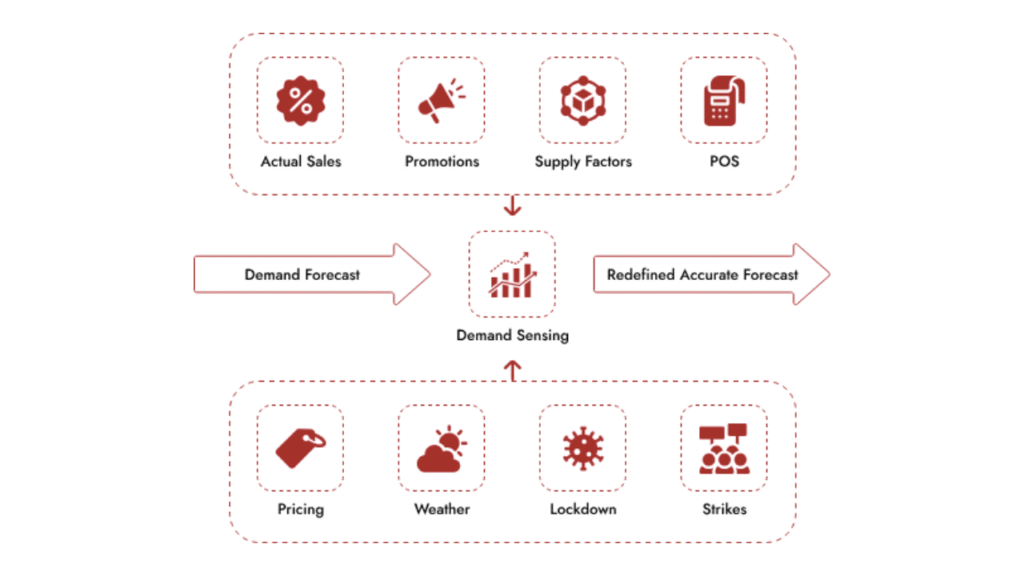
AI demand planning or forecasting tools use AI and predictive analysis to look at historical sales data, your current metrics and competitors, and find patterns to tell you the future demand of a certain product.
Some of these software connect directly to your ERP or POS system and update predictions in near real-time. Some CRM and ERPs have built-in AI demand forecasting modules.
It helps you forecast better and plan your inventory to make the most out of the demand. It also saves you from over-ordering and having your cash stuck in inventory that won’t sell.
Sounds interesting, right? Unfortunately, it isn’t that simple. AI demand planning has its catches, and that makes things complicated.
Why you shouldn’t trust AI blindly in demand forecasting
AI forecasting models are fundamentally backwards-looking. They predict the future by studying the past. And that works until the moment something happens that has no precedent in your data. A competitor shuts down, and their customers flood to you overnight, or your product gets picked up by an influencer, but AI sees none of that coming.
This problem is worse for SMEs than it is for large enterprises. Good forecasting models need volume, ideally two to three years of clean, consistent sales data across a wide enough product range to find reliable patterns. Most SMEs don’t have that.
You might have gaps from when you switched POS systems, a COVID dip that distorts your 2020–2021 baseline, or a product catalogue that changes frequently enough that historical data loses relevance fast. AI will still give you a number, but its reliability and accuracy will be in question.
The second aspect is to have clean and enough data. Large companies have a substantial amount of data and dedicated teams to keep it clean. But SMEs take a hit. Even if they have adequate data, the quality becomes a problem.
The solution: Bring in human intelligence
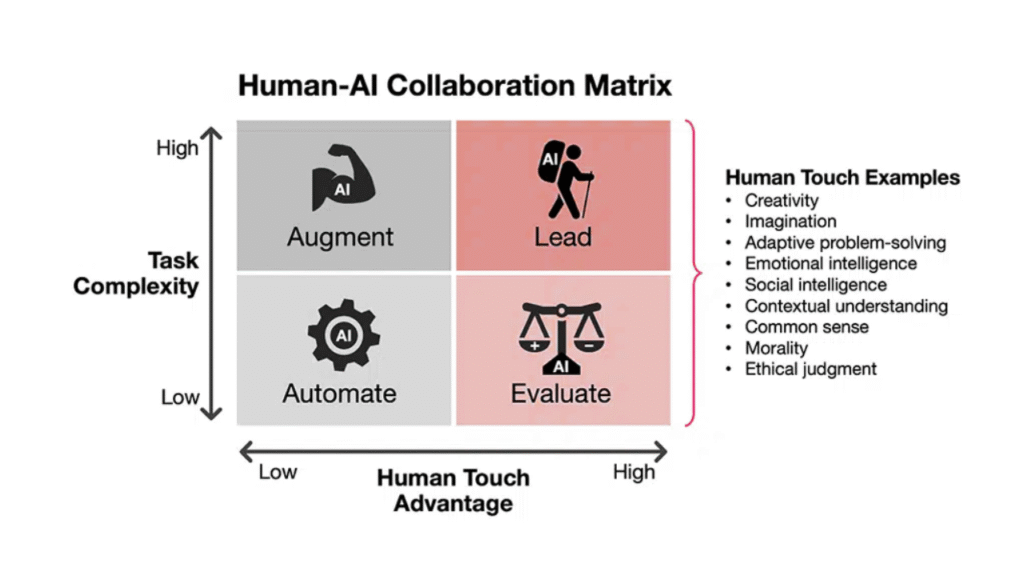
Just like with anything AI, we need deliberate and thoughtful human intervention here as well. By now, we all know we can’t blindly trust AI. We have to logically look at its response and analyse if it makes sense.
Your team knows the context behind different sales dips and rushes. They can make sense of it better than AI. They can catch anomalies and see when AI’s forecast doesn’t look realistic.
Assign someone to review AI-generated forecasts before they trigger purchasing decisions. Critically look at it to see if the number makes sense given what you know right now. You need to have one or two experts to sit above AI and bring in their expertise to judge AI’s response and take over when needed.
The point is, AI can reduce the work, but you still need human context and knowledge to make it work.
Also read: 7 practical ways to better use AI in CRM [CTO’s guide]
Is AI demand planning worth the investment for SMEs?
The software itself is often the smallest expense. What SMEs underestimate is everything that comes with it: the time to clean and migrate your historical data, the integration work if your systems don’t talk to each other natively, the internal training, and the ongoing effort of actually running the human review process we just talked about.
We often forget these factors, but they cost time and energy. So how do you decide if it’s worth it? Consider these three questions.
- Is your supply chain and product line complex? If you’re managing fewer than 50 SKUs with relatively stable demand, a well-built spreadsheet and a person who knows your business will outperform most AI tools and cost you nothing extra. AI demand planning earns its keep when you’re dealing with high SKU counts, multiple sales channels, strong seasonality, or all three at once.
- Do you have enough data? AI only works if your input data is clean, consistent, and has enough history to be meaningful. Feed it garbage, and you’ll get the same back.
If your business is under two years old, recently went through a major pivot, or has significant gaps in its sales history, you’re not ready. Invest that money in getting your data infrastructure right first. Come back to AI forecasting in 12 to 18 months.
- Do you have the margin to absorb mistakes? Every forecasting system, human or AI, gets it wrong sometimes. The question is whether your business can handle a bad quarter if the model misfires on a major purchasing decision. If your cash flow is tight enough that one significant overstock event would hurt badly, the risk profile doesn’t make sense yet.
If you answered yes to all three, it’s worth a serious look. If you got a no anywhere, fix that thing first.
Also read: 4 steps to start AI for operational efficiency [+Examples]
How to start AI demand planning while minimising the risk
Okay, no matter what your business situation is, if you really want to try demand forecasting with AI, here’s a way to minimise the risk and see first-hand if it works for your company or not.
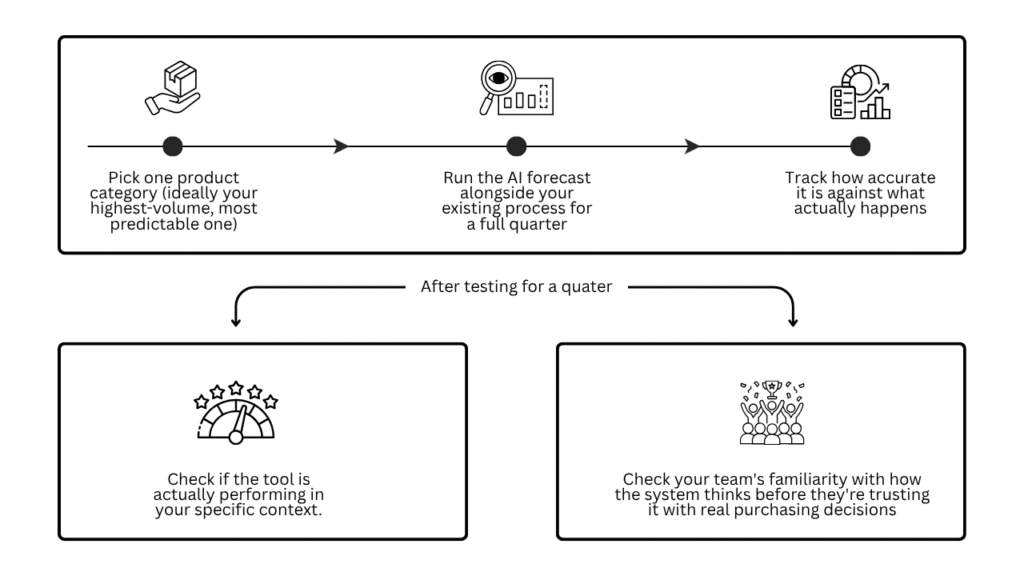
Pick one product category (ideally your highest-volume, most predictable one) and run the AI forecast alongside your existing process for a full quarter. Don’t act on it yet. Just track how accurate it is against what actually happens.
This does two things. It tells you whether the tool is actually performing in your specific context. And it builds your team’s familiarity with how the system thinks before they’re trusting it with real purchasing decisions.
After that quarter, look at the numbers. Bad accuracy at this stage serves as a signal. It usually points to a data quality issue or a category that’s too unpredictable to model reliably.
If forecast accuracy is meaningfully better than what you were doing before, expand to the next category. If it’s not, dig into why before you go further. It could be a possibility that your current business structure doesn’t need AI demand planning at all. This small experiment will give you clarity on how to proceed.
Final thoughts
I hope you got to see the other side of the coin and know whether to use AI in demand planning or not. The businesses that will get the most out of this technology aren’t the ones that trust it the most. They’re the ones who stay the most usefully sceptical.
Start small, measure and compare carefully, and keep your team in the loop at every step. AI should sharpen your decisions, not make them for you. Get that balance right, and it becomes a powerful tool in your operation.


![How to use AI in spend analytics? [5 use cases]](https://feriotti.com/wp-content/uploads/2026/04/1-3.png)