I’ve sat in enough leadership retrospectives to know that most problems aren’t process problems, but people problems. Specifically, they’re a mismatch between how the leader operates and how the team actually works. DISC gives us a framework to align the leadership and teams.
However, most people only go far enough to know their DISC style and never truly do anything with that information.
This piece covers what I wish someone had handed me earlier. From discussing the 4 DISC leadership styles to implementing that knowledge to read your team’s wiring, delegate to it, and communicate, we will look at how you can make the most out of DISC styles.
Ps: I went from a data analyst to a CTO but it took me 9 years. I wrote an eBook that would have definitely cut my learning time by 75% if I had this earlier.
The 4 DISC leadership styles
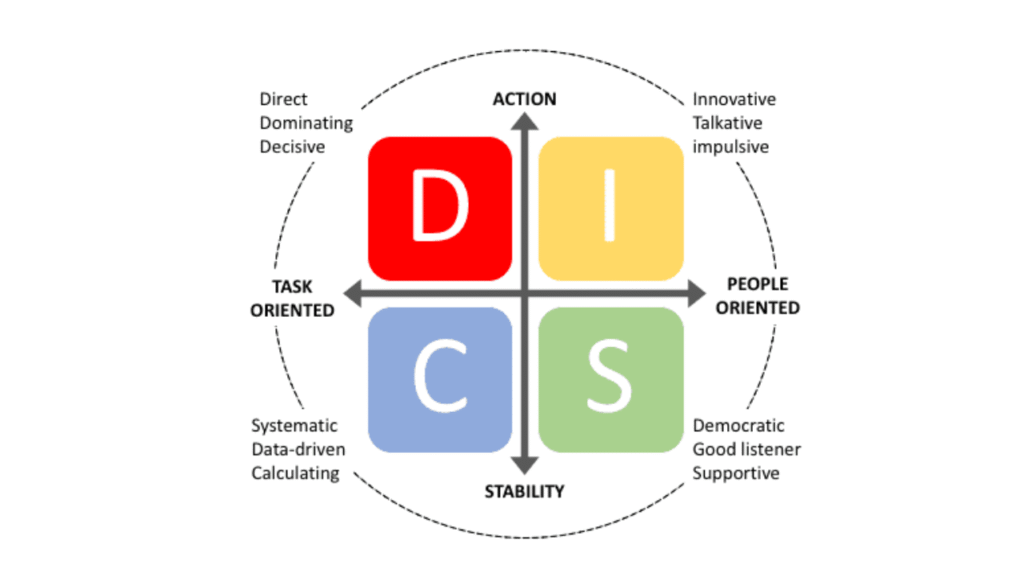
DISC is a behavioural assessment too, and it stands for dominance, influence, steadiness and compliance. Let’s quickly understand each style.
Dominance (D)
A dominant leader is someone who focuses on results more than anything. They are decisive, always looking for efficiency and getting things done fast. Not necessarily rude, but they lead with authority and measure everything and everyone by their performance. In one word, they’re result-oriented.
They perform best when the situation calls for quick decisions and immediate actions. However, in normal circumstances, their confidence and fast-moving style can make others shrink and hold their opinions.
Strengths
- Decisive
- Confident
- Gets things done fast
Weaknesses
- Impatient
- Dismissive of others’ feelings
- Can overpower people
Influence (I)
This is the leader who inspires. They fuel the team with the required positivity and enthusiasm they need. They lead through their personality, charisma and communication. This is the type of leader who would motivate a team to take up a risky project.
Influential leaders roll up their sleeves whenever the situation requires motivation, inspiration and high morale. However, they might not be very action-oriented.
Strengths
- Charismatic,
- Great communicator
- Human focused
- Builds relationships easily
Weaknesses
- Not detail-oriented
- Impulsive decision-making
- Over-promising
Steadiness (S)
Steadfast leaders are reliable and value stability. They create consistency in processes and systems. They nurture harmony among the team, giving everyone a safe and peaceful working environment. As well as, they lead with structures, clearly defined goals and timelines and do anything to avert chaos.
However, steadfast leaders break down during conflicts. They also don’t like risks, as they alter the consistent and familiar environment and processes.
Strengths
- Loyal
- Patient
- Excellent listener
- Creates stability
Weaknesses
- Resistant to change
- Avoids conflict
- Might struggle to set boundaries
Compliance (C)
A compliant leader will go by the book. They would prioritise proper documentation, analysis, reports and all the necessities before making any decision. They keep things in order and maintain the protocols.
However, if the situation calls for quick decision-making, they can stall the progress because of their compliant operating mindset that requires thorough analysis, reports and meetings.
Strengths
- Accurate
- Systematic
- High standards
- Thinks critically
Weaknesses
- Overly cautious
Perfectionist - Slow to decide
You know your DISC leadership style, now adapt
As we’ve seen, every model shines in their respective situation and fails when faced with its weaknesses. So, there’s no one best DISC leadership style. We all have a default style that comes naturally to us.
That’s your DISC leadership style, and that self-awareness can help you lead better and understand your strengths and weaknesses. But I want to ask a very important question here.
Do we only face the situations that align with our strengths?
I bet you said no. Then what will we do in all the other situations that aren’t favourable to our leading style?
You have two options here. You can either continue navigating with your default style or adapt.
The first one’s easy, you don’t have to do anything extra.
- If you’re a D leader, you’ll run through the ideation and strategy phase to let the real work begin, but you might override your team’s creativity.
- If you’re an I leader, your meetings will be motivation-heavy, but the practical steps will be homework for your team.
- If you’re an S leader, you’ll ignore the subtle signs of conflict within your team just to maintain the calm until it surfaces with all its glory.
- And a C leader will not be satisfied turning in a project until it’s perfect, even though the deadline is approaching.
If you notice, in all of these four scenarios, the team is the one who’s taking a hit because the leader is unable to adapt. So the right answer to my question is the second option: adapting.
Adaptability is one of the most important leadership characteristics. Rigid leaders cannot survive in today’s fast-paced and changing landscapes. We need to adapt our style as per the situation.
Is your DISC style negatively impacting your team?
Here are three questions to know if you’re unknowingly sabotaging your team.
- Do your team members ask clarifying questions after you’ve already moved on, or do they just figure it out themselves?
- When was the last time someone pushed back on your call in a meeting? If you can’t remember, that’s the problem.
- Are deadlines being missed in the same phase of every project? That pattern may point to a style mismatch.
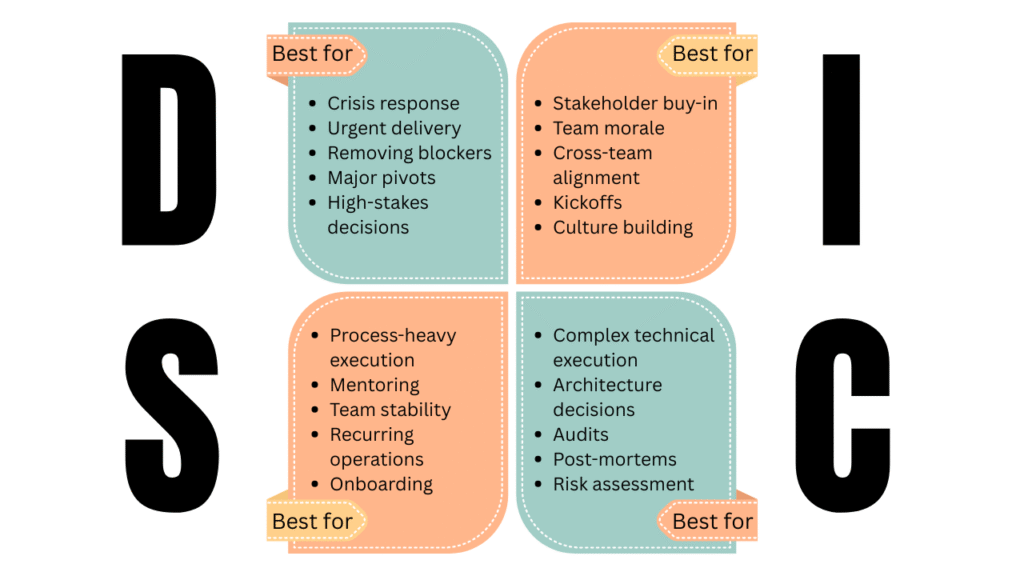
You can look through the above infographic to see when you need to learn into which DISC leadership style
Leading different DISC types
You not only have to be considerate of the situation but also of your team as a whole and on an individual level, too. People and teams also have different DISC styles. For example, a data analysis team will work well with S and C leaders, but a D leader will deem them to be slow. Similarly, every person in the team has their own default style that they thrive on.
If you know your team’s DISC styles, you can lead better and more efficiently. You can delegate better, communicate better, handle conflicts efficiently and match the overall frequency of your team.
Using DISC to delegate
Once you know your team members’ DISC styles, you can delegate tasks that align with their style.
For example, delegate the API migration you need to be done by Thursday to a D member. A CRM cleaning and maintenance project or a quality check audit should go to a C member. The tasks that involve human elements, like leading a demo or running a cross-team alignment call, are an I team member’s task.
Lastly, any tasks that are well-defined and have proper processes will be the best for S members as they thrive in a calm and controlled environment. Ambiguity and unclear instructions are their worst nightmare; save them for someone else, maybe a D member.
Delegation according to DISC types
| Disc Type | What to delegate | What to avoid |
| Dominance (D) | High-stakes outcomes, obstacle-heavy projects, anything needing fast decisions | Micromanaging the approach. They’ll resent it and disengage. |
| Influence (I) | Stakeholder comms, demos, cross-team alignment, onboarding | Precision-heavy solo work, details will slip without a structured partner. |
| Steadiness (S) | Process documentation, mentoring, recurring team rituals, internal tooling | Ambiguous high-pressure tasks with no support, quiet burnout follows. |
| Compliance (C) | Security reviews, architecture decisions, audits, post-mortems | Rushing for a fast answer. You’ll either get bad output or a demoralised engineer. |
Communicating with different DISC types
Another important aspect of leadership is communication, whether it’s with your team or with other leaders and execs. And people understand better if you speak to them in their language a.ka. As per their DISC style.
D people like straightforward communication. I people look for the human element and connection. S are all about details and clarity, while C people prefer a systemic approach.
Communicating according to DISC styles
| Disc Type | Do’s | Don’ts |
| Dominance (D) | Lead with the point. State the decision, the problem, and what you need, in that order. | Over-explain. Long preambles and excessive context will lose them before you get to the ask. |
| Influence (I) | Make it a conversation. Acknowledge them before you get into the task. | Send cold, transactional messages. You’ll get surface-level agreement with no real commitment behind it. |
| Steadiness (S) | Give context and explain the why, especially for sudden changes. Invite the question they’re too polite to ask. | Drop ambiguous changes without reasoning. They’ll comply quietly and spend a week executing the wrong thing. |
| Compliance (C) | Come prepared. Bring data, a clear problem statement, and defined constraints. | Wing it. Vague asks and half-baked proposals will cost you their confidence, fast. |
Put it all into action
I’m wrapping this up by giving you steps to put this knowledge into practice.
- Take a DISC assessment test with your team. You can find multiple paid and free assessment options on the internet. The paid ones will definitely be better, but just start wherever you can.
- Understand your style and its limitations, and work on adapting
- Observe your current delegation pattern and now map it with your team’s DISC styles.
- Pick one team member this week. Identify their style, adjust how you communicate with them for five days, and watch what changes. Then do it again with the next person.





![How to use AI in spend analytics? [5 use cases]](https://feriotti.com/wp-content/uploads/2026/04/1-3.png)