Climbing the corporate ladder is cool until you are back to updating your resume, and suddenly, you don’t know how to make it perfect for your new role or how to make your resume stand out for a lead role. The competition is fierce; recruiters barely give 10 seconds to your resume before deciding that it’s a pass. And that’s the case if your resume has passed through the ATS.
If you’re eyeing that lead, manager, or director title, it’s time to make your resume stand out so it not only passes the ATS but also lands you the interview. I will give you 7 pro tips to make your resume stand out for a lead role.
7 pro tips to make your resume stand out for a mid to senior role
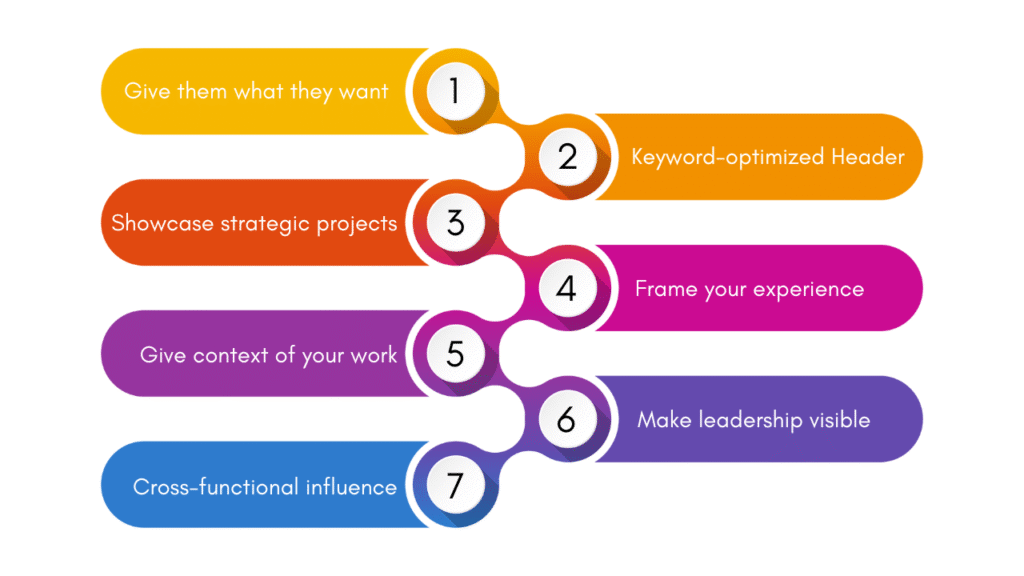
1. Give them what they want
The job description is your best friend for making your resume ATS-friendly. A job description for a senior or mid-level role would be elaborate, clearly listing the role and responsibilities.
Read the description carefully and pick out the keywords, including skills, software, and industry terminology. Use them in your resume and highlight them where it makes sense. It will not only help you head through the ATS but also let the hiring managers see what they want.
2. Header
Have your name at the top and honour yourself with at least one title. You can put the job title to make your resume ATS-friendly. Even better to have two to three titles separated by a vertical bar sign (|). But only do it if it makes sense. Here’s an example for you:
Arthur Feriotti
Director of Data Science | AI & Analytics Leader | Strategic Innovation Partner
A job position and two more titles, each representing a different level of authority.
- Director of data science: formal leadership title, great for ATS.
- AI and analytics leader: showcases domain expertise.
- Strategic innovation partner: frames the candidate as a collaborator who can drive business impact.
3. Showcase strategic projects
Recruiters and hiring managers don’t need to see everything you’ve ever done; they need to see the projects and roles that show scale, leadership, measurable outcome and strategic impact.
If you’re applying for a senior position, your experience section will be extensive. You can group together early technical roles that are not important at this stage, under a short heading like “Early career in data analysis.
4. Frame your experience around outcomes
Entry to mid-level roles requires you to be an executor, and hence you jot down your duties, tasks and responsibilities in your experience. Senior roles, however, require results. When recruiters skim your resume, they’re looking for signals of impact and scale.
Action + impact + measurable result, it’s a simple formula to smoothly tie outcomes with results.
Instead of writing, “Developed dashboards for the marketing team”, write, “Developed automated marketing dashboards, reducing weekly reporting time by 80% and enabling faster campaign decisions”.
5. Give context
While listing your past experiences, write a line defining the company and your role. It gives context to the recruiters and helps them instantly grasp the scale and relevance of your work.
Example:
Senior Data Scientist — NovaTech Solutions (2020–2024)
A cloud-based analytics firm serving Fortune 500 retail clients. I led a small data science team responsible for customer behaviour modelling and product recommendation systems.
6. Make leadership visible
Your resume should make it clear that you’re someone who guides direction, drives impact, and uplifts others, even if you haven’t formally led before.
If you’ve been in mid-level leadership roles or managed projects, show that through the language you use. Use verbs that make your influence unmissable. Words like led, directed, coached, initiated, and developed instantly communicate authority.
Describe how your leadership improved outcomes and enabled transformations. For instance:
- Mentored 5 junior data scientists, improving project delivery speed by 25%.
- Redesigned analytics workflows to align with business KPIs, increasing stakeholder engagement by 40%.
But what if you haven’t led formally yet? You can still demonstrate leadership readiness. Mention moments where you went beyond your role and wore your leadership hat. You can also show influence without authority by highlighting collaboration and cross-team problem-solving
- Proposed and implemented a new data quality framework that reduced reporting errors by 30%.”
- Collaborated with engineering and finance teams to streamline data pipelines, improving decision turnaround time.
Also read: How to demonstrate leadership skills at work without a position
7. Show cross-functional influence
As you move up the ladder, your impact is not only measured by technical results but by how effectively you connect data with decision-makers across the organisation. It demands strategic insight and collaboration that leaders and executives need to direct the company’s big picture.
The more your resume reflects influence, alignment, and collaboration, the easier it is for recruiters to picture you leading. Recall the instances where you or your team collaborated with a different department to achieve a target. It shows strategic planning, that you understand the big picture and can understand how it fits across different departments.
How long should a mid to senior-level resume be?
A mid to senior-level resume should at least be one page, but at this stage, you will have a long list of experience, achievements and skills, so two pages are justified and even appreciated. Overall, keep it concise and most importantly, relevant.
You now know how to make your resume stand out. Here is your next step: Learn how to prepare for a leadership interview, or if you haven’t led before, check out this step-by-step guide to secure a leadership position without experience.
Final thoughts
You’ve done the work, built the expertise, and earned your place at the table. Now it’s time to position yourself as the leader that you are, and your resume is your first reflection of it.
If you’re looking to refine your leadership narrative and land your next big role, join my Data Mentorship, where I help data professionals like you transition from technical roles to lead positions in 8 weeks.







![How to use AI in spend analytics? [5 use cases]](https://feriotti.com/wp-content/uploads/2026/04/1-3.png)